

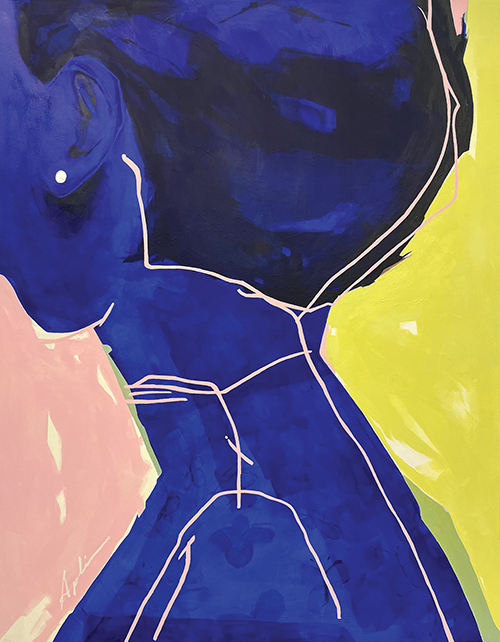
Image courtesy of the artist.
Owen Sound artist Joanna Aplin explores the interplay of tension and release, often alternating between the emotional weight of figurative work and the freedom afforded by landscapes. Balancing detailed planning with intuitive play, she creates works that invite both artist and viewer to look deeper.
Tell us about your background. What drew you to art originally?
I’ve always liked to make things. When I was a kid, I would sew things for my dolls, alter my clothing and attempt to make clothing that I envisioned. I enjoyed the challenge of having an idea and bringing it to life. I would get my mom to draw for me. She would talk out loud about her process and as the human form came together, I was just fascinated with the end result. I also distinctly remember her critiquing her skills, and as I listened I took her words and started trying to make my own figures.
In my high school years, I had the opportunity to go on an art history trip to Rome, Florence and Paris. That trip allowed me to see how influential art is, how it impacts culture, and its role in society. My years at McMaster University really helped me hone my skills on drawing and painting from life and it provided time to learn from other professional artists and peers.
You work in both figurative and landscape art. How do you approach these two genres differently?
Landscapes are quite relaxing for me. I play with them quite freely. Usually what initially draws me to a specific landscape would be the form and colour. Living in Grey County, the landscape is so diverse that I hardly need to use my imagination. There are so many ways to interpret the landscape around me. Sometimes making the decision is the hardest part. But as for the figure, it carries far more weight and requires more of me. It definitely activates a part of me that loves and hates the challenge.
I find that most of my figures are in some way revealing a type of conflict. Maybe that is showing my process, but I do feel people express themselves in so many different, unique ways that it deepens my compassion for the human soul. A couple of years ago, I had a strong word come to my mind to not lose my “Child-like Wonder”. This word has been like a continual big hug as I began to approach the figure in a more playful way.
After working on a figurative piece, I tend to do a landscape right after, just to cleanse the palette, so to speak. That’s how they complement and work with one another. Tension and Release. Isn’t that a great title for an art exhibit?
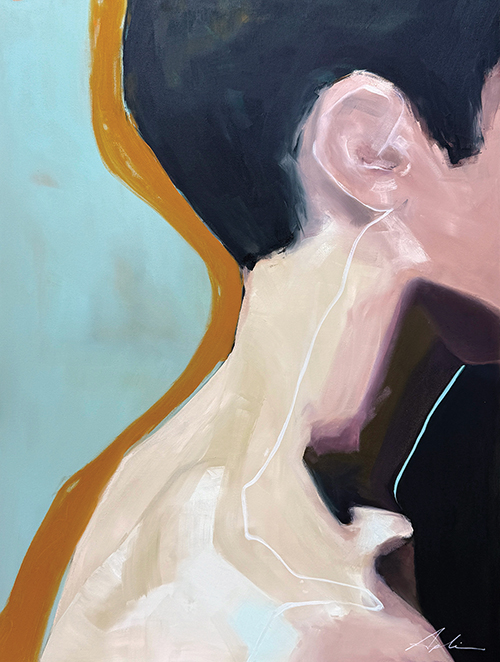
Image courtesy of the artist.
Your figurative work is quite stylized and somewhat abstract, rather than realistic. What led you to this style?
When you’re younger you want to get it accurate, you go through that realism stage. In university, teachers start to tell you to loosen up that line, hold your pencil loosely, stand back more from your work. You start developing better skills and become more aware of the negative space around the figure than the figure itself.
At McMaster Hospital, I would go to the basement, pull out cadavers, and draw them. I was fascinated by all the mechanics underneath. That really allowed me to always keep in the forefront that there’s all this structure, all this working going on underneath. So now when I draw a figure, I’m thinking not just of the contour, but of how that line goes across a muscle, a tendon or a bone. When you see that line crawl across to create form, you step back and think, that’s a different way to look at that person.
In the last five years, the exploration has been more about what can I get away with? I know it’s a figure. I could take 10 hours and do a realistic drawing, and there are still times when I enjoy the skill of that, but exploring new ways of presenting the figure allows me and the viewer to go deeper in our understanding. I believe that is why the human form is such a great subject. I think of Egon Schiele and Alberto Giacometti and how their figures express such different emotional dispositions. You can’t help but experience some emotion towards their work. In my opinion, that is a mark of a good piece of art.
Simplifying forms and lines of the figure is a delicate balance. As my goal isn’t to morph the body into something that it isn’t, it is to offer another way to celebrate its uniqueness. The purpose of a work might be more about its state of being than about accuracy of form.
So it’s not really abstraction, but rather combining realism with imagination.
Yes, that’s exactly right. If I can’t find a figure to do what I need to do, I rely on my imagination to create it. And I like that because it allows a whole other aesthetic to come in. It really stretches my visual skills and leaves the “traditional-ness” at the door. The more discerning you get, the compositions have to have that quality if they are to be created. If the painting didn’t deserve a second look, what’s the point?
Who have been your major artistic influences?
This question can’t be answered simply. There are so many! At different seasons in my life, I had the opportunity to teach art and art history to students. This study deepened my appreciation for different styles and mediums of art, and I would pass along that passion to students. But if I need to narrow it down, I would say JMW Turner, John Singer Sargent and David Lidbetter for my landscape, and Edgar Degas, Henri Matisse and Henry Moore for my figures.
There are other artists like Helen Frankenthaler and Barbara Hepworth who I appreciate their exploration of form and colour. Henri Matisse, in particular, held my attention for a number of years. His ‘oeuvre’ resonated with my process on many levels. Each stage of his work had a purpose for the next. His simplification of the figure and compositions became more playful and yet, remained confident.
Can you walk us through your creative process? How does a painting come to you?
My sketchbook or large drawing pads are my go-to. I draw all the time. It’s how I enter into the day. I get warmed up that way. I’ll leaf through and label sketches, marking which ones I’d like to see larger or developed. My sketchbooks have a variety of landscapes and figures. Sometimes I play with mixing the two together. I have found that intentional ‘playing’ is very fruitful to my work. It keeps my lines and form uncontrived.
Many of my favourite pieces have come from a loose sketch. There is a great need for self-discipline in the creative process because you can’t work faster, so choosing a sketch and then investing the time to develop the composition requires time and patience. With that being said, when I dive into my sketches for ideas of the next piece, many can grab my attention and compete, then I just don’t know which one to pick! Creative overload can freeze the artist from moving forward. So learning how to pace your mind, choosing one and running with it, helps the creative process to keep going.
From those small sketches, I measure the proportions to get an exact enlargement. I learned this about myself, that when I sketch I take into consideration intuitively the negative space around my figure. So that requires getting a stretcher for a painting to the same proportions.
I do write themes down and make voice memos of works in process because I sense connections through pieces and I am aware that my emotional and spiritual state will influence my choice of colours and even line. That can determine what pose of the figure I lean into, as I can more truthfully relate to it at that moment in time.
You’ve incorporated a digital process into your painting practice. How does that process work?
That is a huge part of my practice. When I first started full time, I would work things out on the canvas, but I didn’t like visually seeing the texture of all those layers, the evidence of working things out. I wanted to refine the process so that the intuitiveness and freedom could still enter in, with confidence. I’ll photograph the piece in its sketched form, and bring it into the computer. I can try different shapes, different colours, work out placement. Digital colour isn’t quite the same as paint pigment, so I need to exercise my knowledge of colour theory. I’ll work out my colour swatches and go from there.
Not every piece takes a lot of refining, but some do, and there are still times when I go at an idea and it doesn’t go as planned. This is the risk of creating. When you are wanting more out of your work, and it isn’t happening, you do need to know when to stop in a process.
For example, with my piece Crossing The Jordan, it sat on the wall for three weeks with no red, and I knew it was missing something. I must have tried four or five different shapes digitally for how thin that red line would be and where it would go. Then there’s the steadiness of hand to execute it on the actual canvas, and making sure I will get the correct shade of red because I knew it would be altered going on top of the blues.
Doesn’t that create a risk of never actually finishing the work?
It’s experience. Some pieces naturally just flow along, and the digital process allows me to confirm that it doesn’t need anything more.
With Crossing The Jordan, when I tried bringing the red in horizontally, it was like an incision visually. The piece has a one-to-two ratio, so it needed to keep that vertical dynamic. You learn when a piece says, no, what you’ve got going on is right.
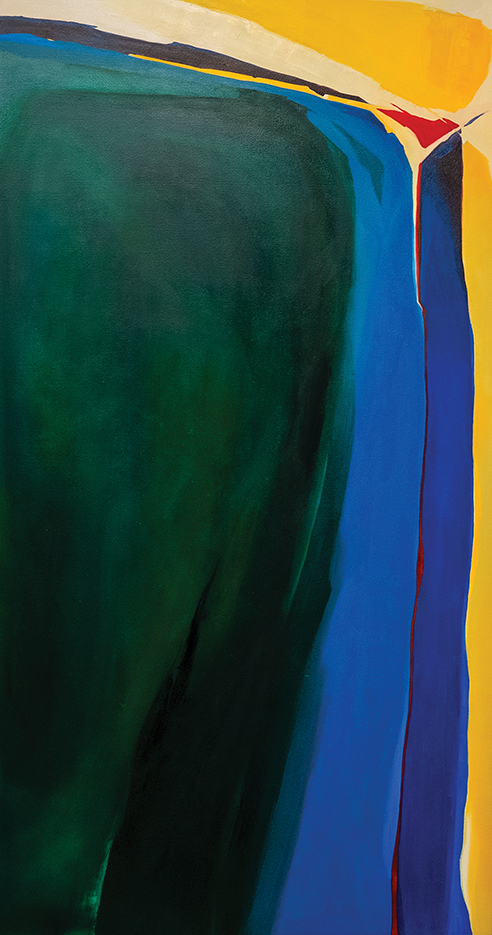
Image courtesy of the artist.
Several of your paintings have biblical titles. How does your spirituality come through in your work?
Some pieces it really influences. Most times with pieces like that, a title will come partly through the painting process, and it holds really true to me. The piece Samuel, for instance—that name came three quarters through. That name helped me visualize the character, purpose and historical significance of that young boy. It informed all the colours.
I chose buttery soft skin tones to emphasize his youthfulness. A faint, but intentional white line, representing the voice of God, relates to a painting called Lady with a Pearl Earring, made early this year in a similar style. There’s another story being written that is governing with great purpose. It is the final element that I place on the piece. Originally, both of these paintings started more realistic, but as each piece developed and title came into play, I wanted to make the unseen, seen, as if to say, God is present in these lives.
Taking a historical painting or story and presenting it in a new light is the type of depth I am wanting out of my work. It’s like breathing new life into something that might have been forgotten.
So in regard to Samuel, the biblical story is incredible—400 years of God being silent with his people, then He chooses to speak through a young boy. The name Samuel means “God has heard,” which gives deeper context to the word “Silence” in regard to the faithfulness of God. Samuel needed Eli to counsel him three times, to know that it was God speaking to him. There’s this gentleness and persistence of that voice. As you’re painting, you work through these things yourself—what are the things I’m listening to? Those pieces are really personal for me.
You have a public-facing studio in the Owen Sound mall. What has that experience been like?
People walk by all the time and say, “Oh, I didn’t know you were here.” I like to think I am a hidden gem. My husband Jamie and I both work out of this space, so primarily it is a studio. Having the gallery has provided opportunities to talk about art with collectors and other artists that I may not have met otherwise. It is tricky to stop working if someone has a question, but I do feel most people have good awareness to only interrupt if necessary, if they see I am engaged in a piece.
What do you appreciate about having that public gallery presence?
This space provides an opportunity to talk about art, answer questions about materials, and what makes a good piece of art. The teacher side of me wants to inform people to appreciate art not only as a hobby, but as a way of living. I want people to experience the process of a work of art. I put up sketches, mini-paintings, and written thoughts on my white board that are needed to influence pieces that are in the creating mode.
I know work can be intuitive from start to finish, that is only one method or part of the process. Many people like to watch and see the tools I use too. It doesn’t compare to watching an artist on your phone.
Any final thoughts on where you will take your practice in the future?
To keep working. Keep creating. Not every piece is a masterpiece. It is a privilege to create works of art. So I’ll just keep working.
Joanna Aplin is a figurative and landscape painter living in Owen Sound. You can see her work in her studio & gallery at the Heritage Place Mall.
This article was published in the November 2025 issue of MOSAIC.
Download the full issue to read more!
