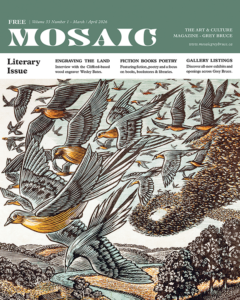
Interview by Ken Bryson
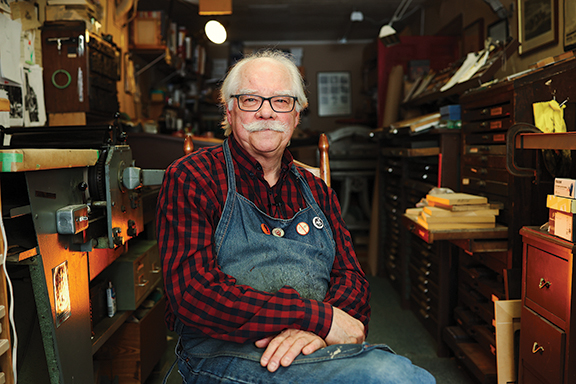
Wesley Bates chose the road less taken. Working in one of printmaking’s oldest traditions, the Clifford-based artist’s career has spanned commercial design, print making and book illustration — ultimately translating rural landscapes and human stories through the visual language of wood engraving.
How did you first get into art?
I suppose it is in the genes. My mother graduated from the Winnipeg Art School in 1947. She studied there with LeMoine FitzGerald and Bertram Brooker, both of them noted Canadian artists of the period. She went on to study in New York at the Art Student’s League. While working a summer job in Banff she and her two art school friends heard that waitresses at the hotel in Whitehorse Yukon were given gold nuggets as tips. They left Banff, went to Vancouver and took a boat to Skagway, and made it to Whitehorse where they did get a few gold nuggets as tips. I have the gold ring she had made for my father to prove it. In Whitehorse she met my father, a fellow Winnipegger and RCMP officer. He was a creative type and very handy as well, who built his own boat so that he could patrol his stretch of the Yukon River.
My mother always had art materials around and she encouraged my desire to draw and paint. I was a lack-lustre student in my early schooling except for art classes. In Grade 5 my parents enrolled me in children’s art classes at the University of Regina. Later in Grade 10 my art teacher took an interest in me and he was my art teacher through to grade 12. He gave me extra projects beyond the prescribed curriculum. The biggest was a 30 foot mural in the physical education department of my high school. I believe he arranged a bursary for me when I graduated, although he would never admit to it.
How did you end up in Clifford?
In the late 1990’s I began working with the Canadian Food Grains Bank, an NGO established to counter famine around the world. My volunteer role was as a liaison between an urban group and a rural group that worked to produce a crop of grain that was then deposited into the Food Grains Bank. The rural group at Letterbreen were my first introduction to the farming community in this area. I made some wonderful friends there. Glenn and Carol Leibold used to let me camp out in an old trailer in their wood lot and from there I went out and sketched the landscapes. Before my daughter Rae left home to go to university she came with me on a drive up to Mount Forest / Letterbreen because I was searching for an affordable place to move to after having lived in Hamilton for about 20 years. I found my place in Clifford, a store building with a huge empty main floor that would hold my printing presses and easels. When I arrived to introduce myself to the seniors group that used the building as a club house I was greeted by a very official in-charge lady who asked who was I and what did I want. I told her I was the artist who now owned the building and she looked me over and said,”You don’t look like an Artist.” I made a point of reassuring them that I would take over the building slowly. My dad had cautioned me that these seniors were not the people in Clifford to piss off.
How did you become involved in the local art scene?
When I moved here, I planned not to join anything for two years. I was going to settle in first and re-establish my illustration business. The first thing I did join was the Minto Arts Council. It’s a good organization with several provincial awards to its credit. The interesting thing is you start on one committee, and before you know it you are on a bunch of committees. At one point, I was on at least six different committees. If there are eight people on a committee, five of them were on other committees with me. That is how small rural towns work.
How did you begin working commercially as an artist?
After I left university the first full time job I found was as a bartender at the Royal Hamilton Yacht Club. I worked there for six years while at the same time pursuing my art work. Over those years I got to know some of the club members who took an interest in my artistic interests. One of those people was the art director at the Consolidated Bathurst Corrugated Box Company. John Hanson was an artist and exhibited his large scale watercolour paintings in places like the Art Gallery of Hamilton. He knew my father in law who was the director of the AGH for many years. One day Mr. Hanson approached me at the bar and suggested I bring a portfolio of prints, ones that especially showed multiple colours that registered with overlap where the colour came together. That portfolio got me my first graphic artist job.
What kind of commercial work did you do over the years?
Wood engraving has been my primary medium for 46 years. But for the 35 years I did commercial illustration I used a medium called Scraper Board. Wood engraving during the Victorian Era was the primary medium for putting an image into print. In the mid 1800’s scraper board was invented to imitate wood engraving. Photography became economical by the later part of the 1800’s and scraper board fit right in the new techniques that photography brought to the printing industry. I was fortunate to work for some of the major publishing companies and graphic designers after I left the corrugated company. I illustrated for periodicals, advertising, book publishers and also for independent fine presses that made books by hand.
How did you come to work with the poet and activist Wendell Berry?
I came across Wendell Berry when I worked as a bartender. On mid-winter evenings when the club was deserted I would take a break and watch the Dick Cavett show. One evening Cavett interviewed this gentleman who talked about farming and rural communities. I found it fascinating and I became a fan on the spot. About 20 years later I was attending a Fine Press Book Fair in Delaware where I came across Gray Zeitz of Larkspur Press, stuck in a corner, but with the largest array of book titles in the whole place. As I looked at the titles on the spines I saw Wendell Berry again and again many times. I asked Zeitz, who was dressed in jeans with suspenders and a T-shirt with a chest pocket, if he knew Wendell Berry. He smiled and said that Wendell lived across the river from him.
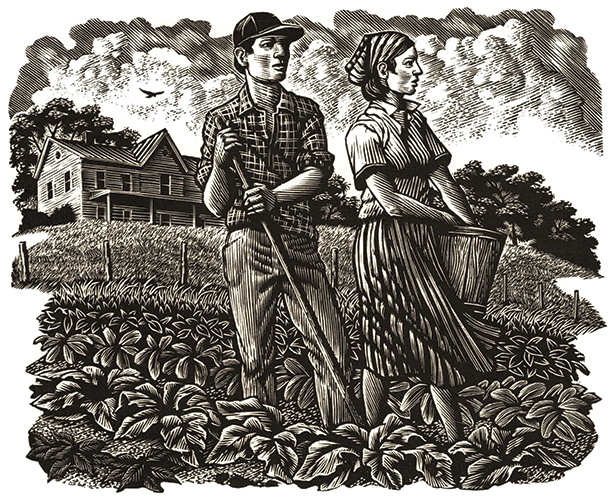
I was at the book fair to see if I could drum up some wood engraving illustration work. I had in my car a portfolio of engravings that I had done to accompany eight of Wendell’ poems. I was planning to publish the poems and engravings under my own imprint, West Meadow Press. I had picked the eight poems because I thought they expressed what a farmer thinks about while he is working. I retrieved my engravings for Wendell’s poems and showed them to Zeitz and after looking them over he said I should show them to Wendell. Well, I laughed and thought that lightning would strike me first. But thanks to Gray Zeitz I made a trip to Kentucky the next year and met Wendell and presented him with a copy of my book of his poems with my engravings titled Roots to the Earth. That was 1997 and I’ve been traveling to Kentucky almost every year since to work with Gray and sometimes to visit with Wendell and his wife Tanya.
Larkspur Press has commissioned me to illustrate ten books of Wendell’s poetry and short stories.
What is the difference between woodcut and wood engraving?
Well, let’s start with a bit of history. It is agreed by historians that Thomas Bewick ( 1753 -1828), a metal engraving by trade was the first to develop wood engraving as an art form. In the late 1700’s the usual way to illustrate a book was use an etching or a metal engraving. Bewick was looking for a more economical way to put an image into print. He chose to use a hard dense wood and turn it so the endgrain was the working surface. He had the block milled to the same dimension as type, which allowed the printer to place the engraved block in the same press as the type. That was a major breakthrough for the printing industry and wood engraving went on to become the premier illustration medium throughout the Victorian period. I tell people, if you have a book printed between 1825 and 1860 it’s almost certain the image is a wood engraving.
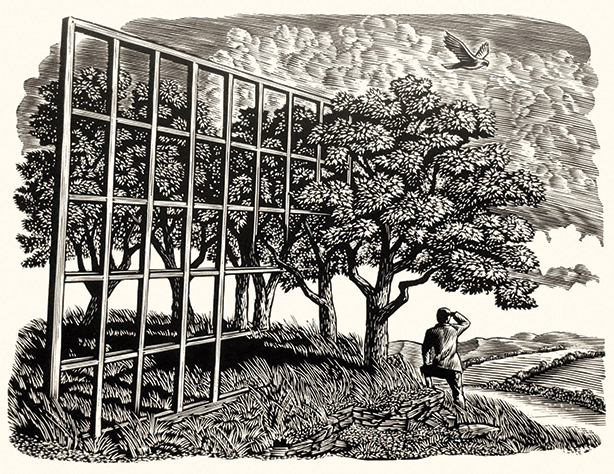
Because Bewick was familiar with using his engraving tools to engrave lines that when printed onto paper showed a black lines. When he moved to endgrain blocks he just carried his engraving tools over but instead the lines in wood showed up as white marks in a black surface. The trick being that the white lines are what has been engraved and they are telling the story. Think of drawing on a black board. It was a revolutionary change in the way an image could present an image.
There is often confusion between woodcut and wood engraving. They are both part of the relief print medium which also includes Linocut, and even the humble potato stamp. The difference is how the wood is used. Woodcut, the oldest of the two, is worked on the side grain, think table top grain. To work on side grain the artist must use the knife family of tools, chisels, U gouges, V gouges and planes.
Wood engraving is worked on the endgrain, think tree stump. On the endgrain the artist uses the family of gravers, of which there are too many to list but my favourite is called a Spitsticker. Gravers are used on metal and endgrain wood.
You are working on a wordless novel. Where did the idea come from?
About 35 years ago, I thought I needed a hobby so I took up fly fishing. The idea for my story came from both daydreaming while fishing and from a few experiences I’ve had while I was on the river. I played around with sketches for a few years and a publisher saw the sketches one time and suggested that a book might be developed from them. That project never went to press.
Over the years I have enlarged the scope of the story and at some point I realized that I had a narrative, a story arc. The story has been through five drafts and finally I sent it out to a group of readers. The critiques that came back have been so valuable and now I am in going through a sixth revision. I hope this is the last one before I start on the engravings.
What kind of work do you naturally gravitate toward?
I like this question. When I was doing commercial illustration I had draw all manner of subjects. I once showed my portfolio to an art director who was looking to hire someone to illustrate a pair of shoes. In my samples I had an illustration of cowboy boots. When he saw the boots he said ‘Can you draw shoes?’
So I took out my sketch book and drew a pair of mens shoes and hoped that he wasn’t going to say he wanted women’s shoes. But the question is what do I gravitate toward when I am just working for myself. Generally I love figurative images and in particular images of people with the objects of their life around them. And I tend towards realistic images but not like a photograph. Call it interpreted realism maybe.
Wesley W. Bates works full time as a printmaker, letterpress printer and painter under his own imprint at Wesley W. Bates Gallery and West Meadow Press in Clifford Ontario Canada. In his gallery he features paintings, original prints, wood engravings, handmade books, letterpress art, broadsides and custom Ex Libris. His wood engraved prints have been exhibited widely and are held in public and private collections in China, Spain, Japan, England, the U.S.A. and Canada.