

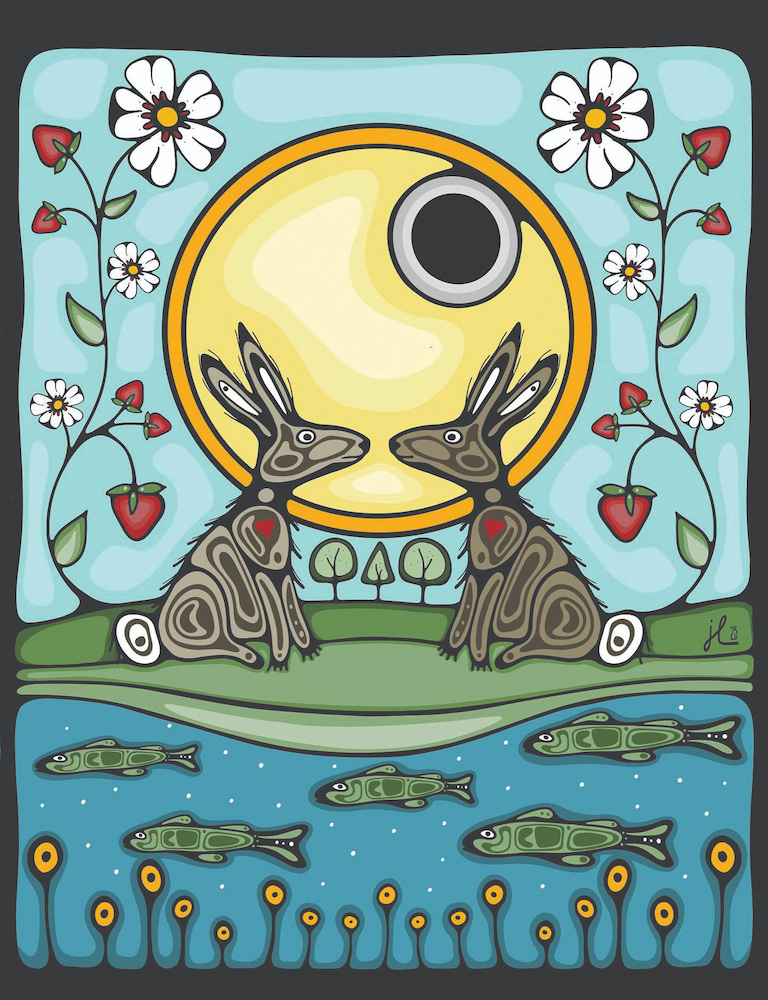
Drawing on a practice of architecture and her Anishinaabe heritage, Jeannette Ladd’s work weaves cultural symbolism — herons, seed pods, spirit lines, sacred water — into paintings and large-scale found murals across Bruce and Huron counties. Jeannette’s designs carry Ojibwe culture and history into community spaces, most recently as the winning design for a new Saugeen Beach sign.
When did you start making art?
I started creating either art or making things from a very young age. I was beading when I was young and in elementary school. In high school art was one of the things that I did. I was strong in art and in math and that’s the reason I went into architecture, because those two things complement each other. So it gave me the opportunity to design spaces, but also have that more mathematical approach to spaces as well.
I worked in architecture for maybe ten years, at a small firm in Oakville. We did a lot of large industrial buildings, and residential buildings as well. One thing I was good at was building large-scale models. I would have to create the buildings, have the airplanes, the trees and everything. So it was sort of like a sculptural piece. It was very rigid, you know, I had to follow the drawings, but it still gave me the outlet to create something.
And then I felt that I needed to come back home. So I came home and I’ve been working for my community ever since. I work in finance full time. And with that, I also needed a creative outlet for myself.
Was there a specific moment that shifted art from something personal into something you pursued more publicly?
I’ve been doing arts ever since I moved home — paintings and things like that — but I didn’t really show my work to anyone. It was more just for myself. And then my mom asked me to illustrate a book she was writing called Memengwaa: The Monarch Butterfly. That was the first project I did where people saw it, other than family. It was the start of things, and then it just kept going from there.
Then there was a call out for artists for a mural in Paisley where they wanted to represent the two rivers coming together, and I put in a sketch. I never thought I would be chosen. And then the person called me up and I was very surprised. Doing it at home and for yourself or for family, it’s different when you bring it out to the real world and people see it. So that was sort of the start, and then ever since it’s just been one project after another.
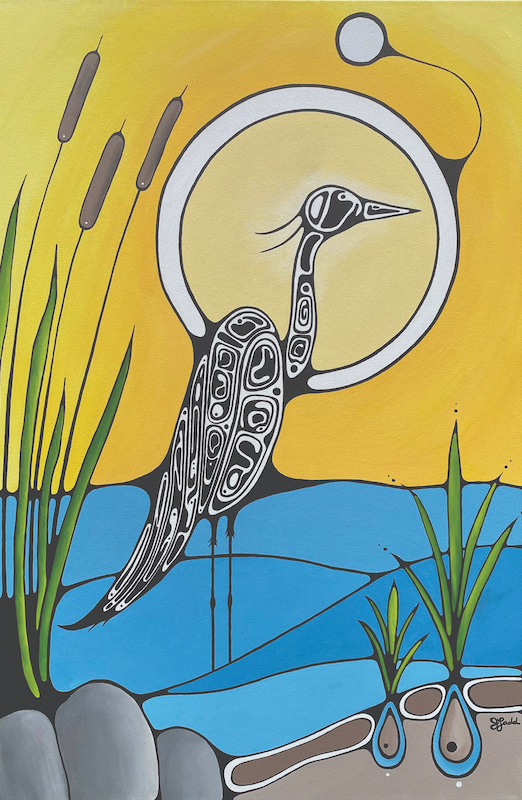
Image courtesy the artist.
Was it hard to take on the butterfly book?
Yes. I normally did acrylic on canvas, and for the book I had to do digital artwork, which is totally different. This was the first time I was on my iPad creating things. I was very nervous about that. But it’s actually quite nice in a way. With the flowers, I could copy them and use them again, where with a painting you would have to paint everything fresh. So it’s just another way to create art.
It was very scary to show people. Even posting on social media, you don’t know what people are going to say, or if they’re going to like it. I post mostly everything that I do, but it’s not because I want people to see my artwork. I want people to know that my culture is still there and that the culture is very beautiful. There is so much in our culture that I want to just portray as beautiful. I want people to talk about it — like, why did you put a rabbit in that piece? Well, this is why.
Before you came back home, you were doing portraiture which is quite different from the work you make now. Was the shift to your culture a conscious one?
I think I was at a spot in my life where I wanted to show my culture. That’s what it really was. And I think being back, working for my nation, being more part of the community compared to being in Oakville doing architecture, it’s a totally different type of life. I was there for ten years, I came up here. And I think there was a reason, and maybe this is the reason.
Tell us about the animals in your work, how do you choose them?
Within my culture, certain animals represent certain things. They represent either the person the piece was for, or where the piece was going to go.
Guided by the Heron was a piece for my father. The heron represents patience and stillness and a quiet strength, and those are the qualities that my dad has. Most of my pieces have water in them. Water is very sacred to Indigenous people and to me. I love to go down to the water and hear the water hitting the shore. But water also holds our fish and it sustains our life.
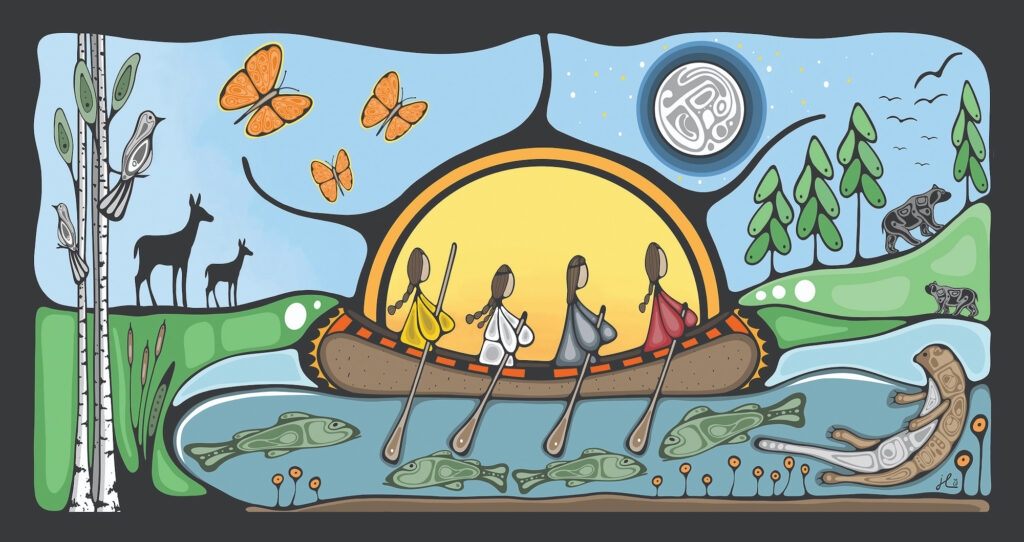
Image courtesy the artist.
And the designs inside the animals?
I call them spirits. The sun is the grandfather, the moon is the grandmother. I also like to put stars, which talk about our ancestors. We still have to remember the past while going into the future. So that’s why I try to put our ancestors in there as well.
I also have seed pods in a lot of my pieces. Something starts out so small and it could become a large tree. But it starts out just as one single seed. And that’s what those seed pods represent to me.
Can you tell us a little about the Woodland painting tradition and where you sit within it?
Yes and no. I feel there is a connection in regards to relationships that we have with the sun and the moon and things like that. And yes, I think Woodland artists do the same thing. Daphne Odjig is one that I truly love. From the beginning, when she was sketching, compared to her artwork at the end, it was so different. But she did have symbolism within her artwork. So I’m not sure if mine is truly Woodland. I haven’t really named it.
Do you approach murals differently depending on the community or context?
Oh, for sure. For Stratford I went down there, I saw the actual space. I knew it was going to be a gathering space, maybe for movie nights. I spoke to the director and to other people as well, and I got a sense of the feeling behind the piece I wanted to create.
With the Paisley mural, I’ve been over the bridge and through Paisley so many times, but to get out of the car and actually see the river, and see where the two rivers meet, you get a sense of that space. And that’s what I want to bring to the piece.
Does your architecture background inform how you approach mural work?
Yes there’s that spatial awareness. Like at the Aquatic Centre: people are actually walking beside the mural. And the Huron County Museum mural is ten feet up in the air with different perspectives. So yes, architecture has given me some skills of design.
What’s your process for larger murals? Do you ever bring in help?
For some I’ve worked alone. The Huron County Museum mural I had to get certified to be in a lift. I had never been in a lift before, but you do what you have to do.
For Stratford mural at the Children’s Aid Society, I really wanted to do that one. The director wanted to change the view of CAS to Indigenous people, because of the past where children were sent off and they lost their culture. He wanted a mural that represents not forgetting that, while also showing how things have changed.
At the start of the mural it’s all black and white — the flowers have lost their colour, which represents losing the culture. Then there are butterflies, which represent change. And the large item in the piece is a turtle, which represents our earth, Turtle Island. On top of the turtle is a fancy dancer, they dance as butterflies, and change. And then on the other side, it’s all in colour. I want people to think: why isn’t there colour at the beginning? And maybe someone will tell them the story of what happened, and how things have changed since then. For that one I had two helpers and we did it over five days. It was a big project.
Is there something you hope stays with someone after they’ve experienced your work?
The respect that we need for our environment. If we don’t keep our waters clean, what’s going to happen? My great-grandmother canoe’d and portaged all the way here. We use the water for food and for medicines. And if we take something from the earth, we give tobacco. It’s a pause and a respect for what you’re doing. I want people to feel that.
And even for the other beings that are part of our lives. My mom is a monarch butterfly person. She numbers them, they fly to Mexico, she feeds them and does the chrysalids. If we lose one, we have lost a lot more than just one. We have to be mindful of what we do.
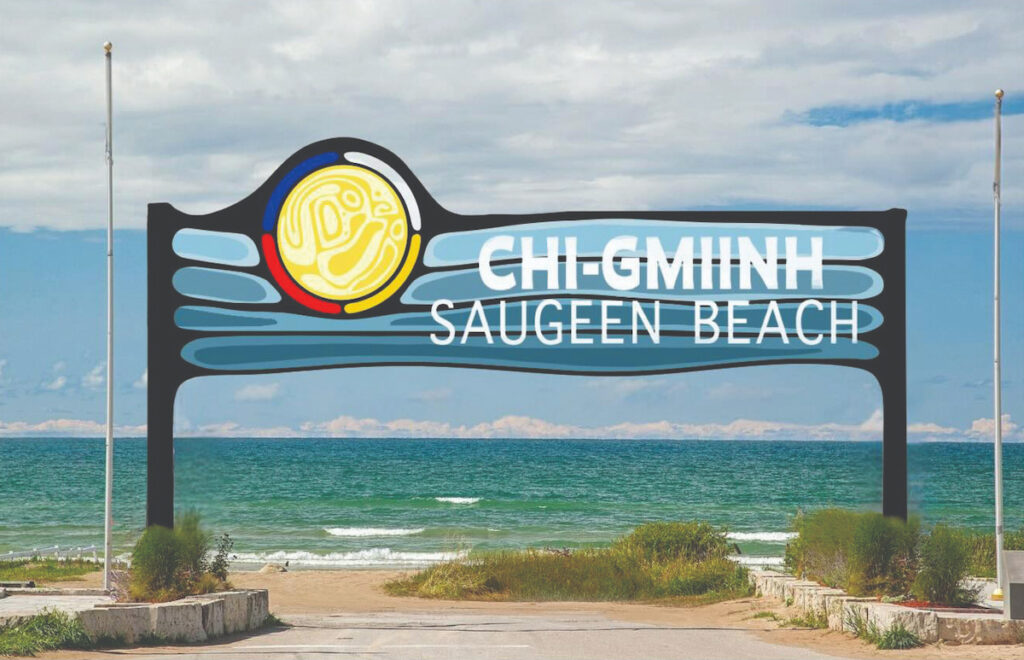
The recently announced new design for the Saugeen Beach sign used your design, and came through an open community process and a public vote. How did that feel different from a typical institutional commission?
Usually with my projects I submit a sketch and it goes through a committee or jury. But this one was done through our beach committee — the chair and co-chair are councillors from our chief and council, and community members sit on the committee, so the community has a say. I believe they selected three finalists and it was put out to the overall community to vote, and our names were not tied to them.
Can you walk us through the design?
My favourite spot is the water and the beach. If you look at our history, in the 1800s the beach was called Chi-gaming. What I wanted in my piece was for the Ojibwe words to be a lot larger than the English words. So when you look at it, it says Chi-gaming, and then below that is Saugeen Beach.
Chi-gaming means Deep Water. So you can see in my piece that there are bands of blue which represent the layers of the lake. It goes from lighter blue to darker blue to represent the depth.
And then there is the sun. The beauty of the beach is that every night the sun sets on the beach. So I wanted that to be part of the design. The sun is above the water, and there is a ring around the sun which is the four colours of our medicine wheel. And within the sun there are the spirit lines as well.
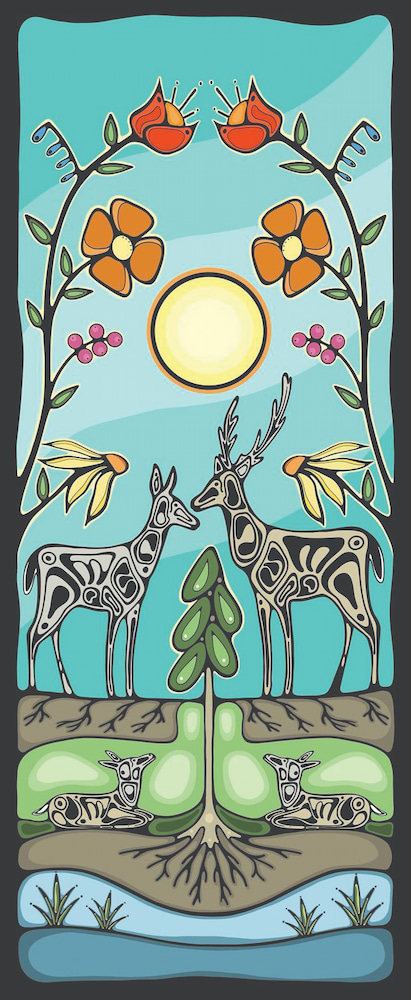
ROOTED IN FAMILY AND GUIDED BY THE LAND (2025).
Image courtesy the artist.
What does it mean to you that your art will become part of the visual identity of Saugeen Beach?
When it was posted on social media, for days I didn’t even look at it. A family member said it was up there and I couldn’t believe some of the comments that were coming and the likes. I was very humbled. I didn’t think it was going to be like that.
Do you think community members will experience the sign differently than others?
Yes and no. There is so much history with our beach. I remember myself going down to the beach as a child. We would come to see my grandmother and we would always have to spend the day at the beach. But I’m also hoping that someone not from Saugeen sees the sign and sees it as the beauty we want to portray. It is very special to us, and hopefully the sign indicates that. We want to share our beach with everyone. It’s not just our beach.
Can you imagine what it would have meant to you as a child — going to the beach, walking under a sign like that?
Oh, for sure. Definitely. When the sign was changed from Sauble Beach to Saugeen Beach — the feeling — like, I could cry right now. I drive past there every day to go to work. And now when I look down there, it’s just the pride. Like, we finally put that up there. It has been our beach for so many years. To show our name there — it’s just something else.
And how do you hope the physical sign will look?
One thought is to have it be thick acrylic and colours, where it’s not solid, where the sun can still shine through and you can see the colours on the sand. That’s what I would love for it to be. The colours will dance on the sand. Those are my hopes.
How would you tell someone about Saugeen First Nation who has never been here before?
Saugeen is a close community. We feel for each other on different things, loss or achievement, we are all rooting for everyone. And it is a large community with things happening in different areas. We have the amphitheatre with the Saugeen River, we have the beach, we have the land with the trees. There are little pockets, and different things going on in each one.
And our powwow. We have fabulous dancers and drummers. When you hear the beat of the drum it just resonates within you. It just takes your breath away. So if you can experience the drumming and the dancing, take it all in.
How did your family come to this area?
My great-grandmother’s name was Lillian Wabizi. She and her family canoe’d and portaged their way here from Michigan, near Mackinac Island, in the late 1800s. She was Potawatomi and she only spoke Ojibwe. They settled in Saugeen.
My great-grandfather went to both wars, and my great-uncles went with him for the Second World War. So my great-grandmother was left at home with fifty acres of farming to do while they were at war. And then the farmhouse had a fire and it burnt down. Within our family, we have lost a lot of photographs and things like that. So when my mom comes across someone who may have a picture of her family, she tries to gather those things up.
Are there old stories about this area that you’d like to share?
There are so many stories. There’s the story of how the beaver got his tail, those sorts of things. And there’s the creation story. I’m doing a piece for one of the universities, and it’s the creation story. Where no one else could dive so deep into the water to grab that piece of soil but it was the muskrat, the littlest one. The beaver couldn’t make it, the loon couldn’t get down there. But the little muskrat did it, and he grabbed that piece of soil and put it on the turtle’s back. So those are the stories we still talk about.
What does it mean to you to be Anishinaabe-kwe, Ojibwe?
I love my culture. I wish I spoke the language. My two-year-old great-niece says ‘bomo pee’ when she leaves. Growing up, I didn’t know any of my language. And it’s not because my mom didn’t want to teach me. Back then it just wasn’t something that was done. Going to school, she was told not to speak the language. So it was hard for her to keep the language going for herself and then teach her children.
Our language is our culture. If we lose that, what do we lose? So yes, I would love to speak Ojibwe. I know it’s very hard to learn when you’re this old, but I do know a few words and I try to add new words as I go.
Being Anishinaabe the other thing is the stories that come up in my pieces. I want those pieces to live on. Maybe when I’m not here, people will talk about them and wonder why there are these lines within these beings? There is just so much in our culture. And it’s right here. Other cultures are very beautiful as well. But we as Canadians have Anishinaabe that are right here, with a beautiful culture too.
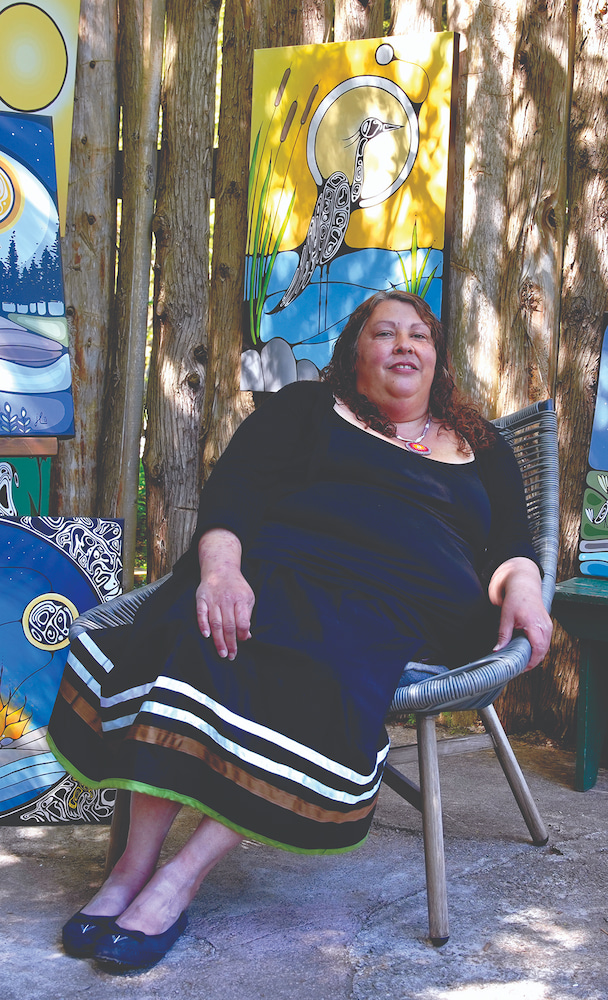
Jeannette Ladd is an Anishinaabe-kwe from Saugeen First Nation, who creates paintings and mixed-media works inspired by the land, stories, and teachings of her community.