

Image courtesy the artist.
How did you come to reside close to Meaford?
My family moved from the UK when I was about nine. So I basically grew up in Canada, but lived in Toronto basically my whole life. When we first moved and realized we were going to stay, my family was looking for a place, and we looked at all these different cottages. When they came to this area, it felt very English. Almost more English than any of the houses we ever lived in in England, that kind of country lifestyle. That was what drew us here as a place.
Then when COVID happened, I came up to ski with a friend and I just never left. It occurred to me that there’s no reason to be in a basement studio in Toronto when I could be here, surrounded by nature, with a much better quality of life, in my opinion. It was not even a question.
What’s it like for you being a working artist in a smaller community?
At first I almost treated it like Toronto is the main hub and I’m more isolated here, although still close. Then you realize more and more that there’s so much going on here.
At the same time, social media has grown exponentially. So in some ways I became more isolated from the arts community in Toronto, and yet suddenly became more connected through social media, and I was able to use that. In a weird way, it just flipped. And over this past summer especially, I’ve become more and more connected out into Meaford itself. Your circle widens, and then you find out people are doing all sorts of things, like the various crafts in the Clarksburg area.
It also feels like there are a lot of people moving to this area who are creatives and running their own businesses. I don’t know if that’s actually a recent trend, or if I just see it because it’s what’s happening to my friends.
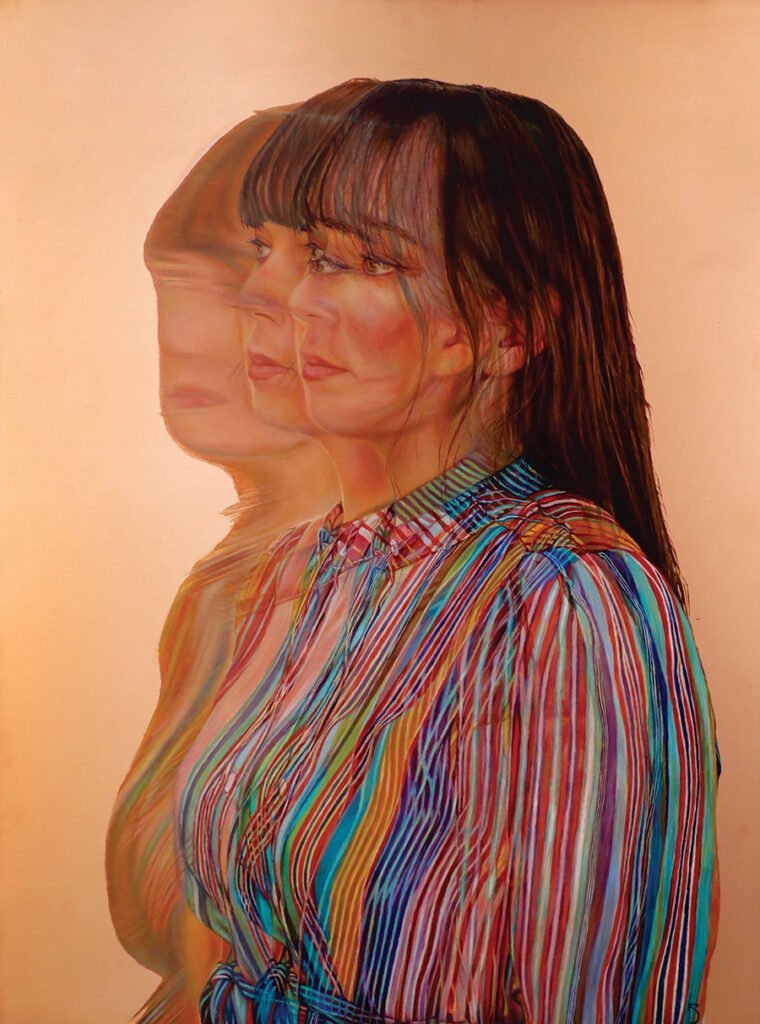
Your portrait Stripes was accepted into competition at the National Portrait Gallery in London. How did that come about?
It’s the biggest portrait competition in the world, and I grew up looking at it. As soon as I was able to, every now and again I’d apply. I was telling everyone how excited I was to have made it to the final round of judging, because even that is an achievement. I never expected I would get into the exhibition itself. It’s been quite surreal.
I got to go over when it opened, and there was a week of events and press events. I went every single day I could. It goes on tour now so I won’t actually get the painting back for a year.
When the news of your portrait in London came out, the story was picked up locally. How did that feel?
I was very grateful for some local media interest. That’s another thing you realize moving to a smaller town: there’s so much support, and everyone’s really excited. There’s a sense that people are really invested in this community and what’s happening around them, and that’s been really meaningful to experience. It makes you feel less like you’re just living in a place and more like you’re actually becoming part of it.
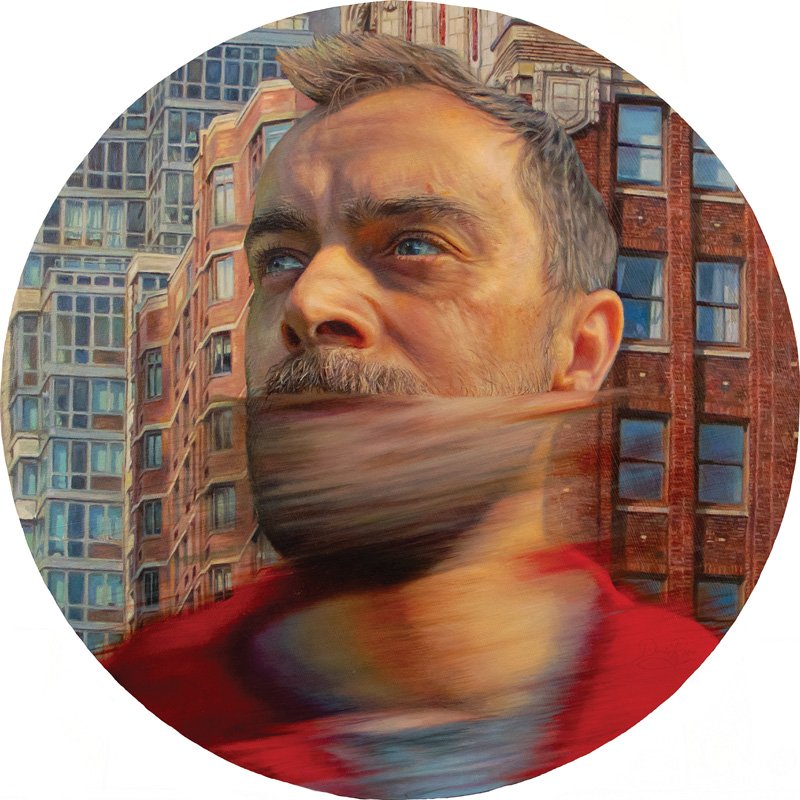
Image courtesy the artist.
How did you become a painter?
I went to OCADU, to art school, straight after high school, and I did drawing and painting. I knew from a very early age that I wanted to be a painter, and a portrait painter specifically. Everything was just getting through the hoops of “this is the ultimate end goal.” Then I went straight to being an artist after that, and I’ve learned a lot the hard way.
What did you learn the hard way?
It’s probably good to be idealistic, because otherwise you wouldn’t do it. You would just realize how crazy difficult it is. But I almost wish I could have approached it with more of that small business mindset sooner. You almost have to unlearn some of these ideas that art is above being commercial. That’s not why I do it, so you sort of have to compartmentalize.
I bought a bunch of books on art business, and I remember reading this quote about a ratio, I don’t know if it was 80/20, something like that. I was like, “That’s ridiculous. How could you only spend 20 percent of your time making art?” That was very idealistic of me, to imagine you could spend most of your time making art, and then some people would find out about it and just buy it because they love it. Luckily there’s still enough painting that it makes it all worthwhile – thankfully more than 20%.
What draws you to portraits?
It’s hard to say exactly, because it’s always been the case. I’ve always loved drawing and art, but I find the most interesting subjects to be people. There’s something about a way of connection. You learn a lot about the person when you paint them. Not just because you often spend time with them to draw them or get images of them, but because you talk about the ideas and the meaning. It’s sometimes unusual for people to see themselves, and you learn how they view themselves.
It’s challenging, too. Our brains are so wired that the slightest difference in a line is where the likeness is. It’s just always been my favourite subject matter, through what I’m interested in, what I find beautiful, what I find compelling.
Some of your recent paintings are less realistic, with motion blur and even double-exposure effects. What are you after with those?
That’s my most recent series, and it’s been to convey symptoms of chronic migraine, which I’ve had forever. I had the idea for this series and then stepped back from it, because I couldn’t find a way to do paintings that represented the feeling of having chronic migraine without it being super obvious. You keep going back to “an axe in my head,” or “I’m staying home,” things people already see on the outside. It’s not really saying anything more than people already know.
So I stepped away. Then I got interested in these almost fake photographs, with bad photographic elements, all blurred or double exposure. I thought, “Oh, great, this actually conveys it a little bit more than anything else I’ve done.” It conveys that dissociation and sensory overload: not necessarily the pain, but the symptoms that are maybe lesser known. The way you notice everything, the way everything is turned to pain, and your brain is always on the brink of being pushed over the edge. Noise, sounds, light, all of these come into play. Each painting is trying to do something a bit different, and the one in the National Portrait Gallery is part of that series.
(Oil on canvas, 2018).
Image courtesy the artist.
What do people come to you for when commissioning a painting?
It’s so varied. I advertise myself as a portrait artist because that’s my main interest. But when people approach me with whatever ideas they have, I’m usually pretty flexible, as I love helping someone use art to express something meaningful. Sometimes they have a specific vision they want me to create, or they just want to say something about a meaningful person, place, or memory. I like being able to take that idea and turn it into something tangible that they can keep or give.
So I can end up doing somebody’s first house, or digital paintings. Many of my commissions are digital. I just finished a digital painting of a collector’s cat who’s passed away. So I’m mainly doing portraits, but it tends to be quite broad, and sometimes very specific to the collector.
How involved are clients in the process?
For commissions I love getting to know what someone is envisioning and figuring out how to make that work as a beautiful work of art. At the same time, collectors are coming to me because they want my artistic input and creative choices, taking their ideas and intentions as a starting point, then bringing my own perspective and experience. It becomes a bit of a conversation throughout the process, and the amount of involvement is completely different with every commission. A lot of the involvement happens at the start of the process. So the beginning stage is: I’m doing a sketch, this is what it’ll look like, these are the colours I’m going to use.
For my own artworks too, a lot of the decision-making happens before the painting. It’ll be sketches, or I’ll use my iPad to collage things. I do a lot of my sketching on the iPad now, because you can move it easier, change it easier. Often it’ll be meeting with somebody, sketching them, taking pictures of them and using all of it. It’s a combination of everything, because you may as well use all the tools to your advantage. I’m not so tied to the image, and you have to take some artistic licence, but I know what I’m going to aim for before I begin, because all the thinking has been done.
How much of the sitter’s personality do you bring into a portrait?
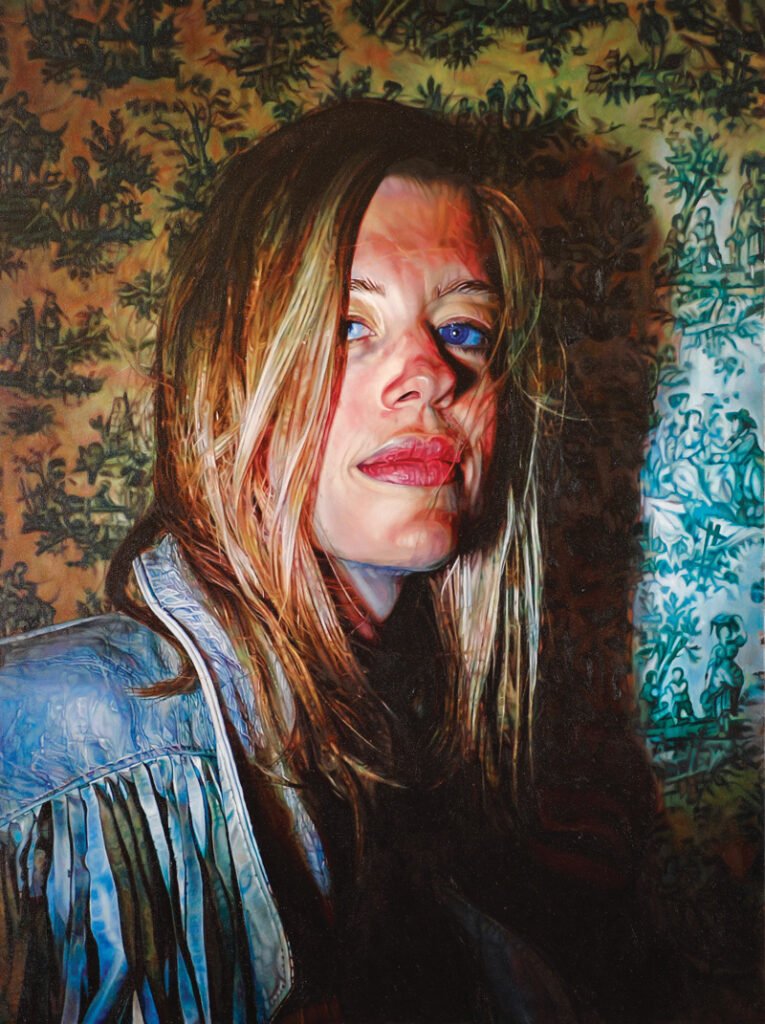
I’m a realist painter, so I care a lot that it looks like the person. But I do love to add little touches that are personal. If somebody says something to me, I’ll mark it down and find a way to bring that in. It matters to me that it feels like the person, whether that’s through expression or something more symbolic.
Who are your influences?
At university I was most inspired by artists like Jenny Saville and Lucian Freud. I was very painterly, and I loved the texture of paint and all the character that came from that. Then when I left university I had more time, and I wanted to push myself. I wanted to learn classical techniques, start using glazing, look at dynamic light and dark, and become a realist painter in that sense. Now I’m starting to merge the two a bit more. A little more textured and free, combined with the sense of depth and light that you get from classical techniques.
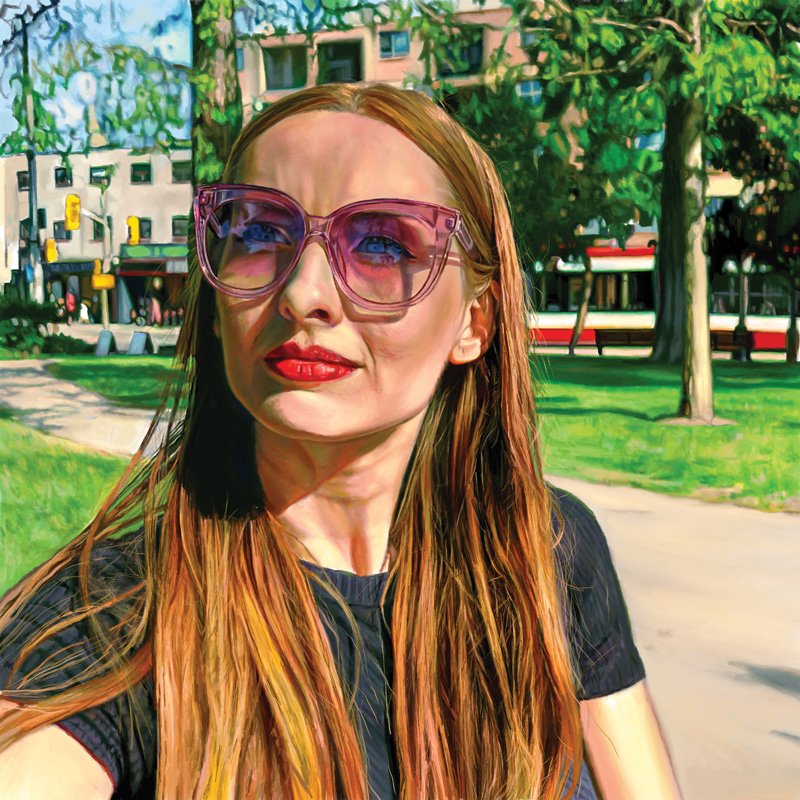
Image courtesy the artist.
Do you approach digital painting differently from painting with paint?
I approach digital painting the exact same way. People are using layers and I’m like, what are layers? I just use the Apple Pencil and the digital brushes and draw it. What’s been fascinating is that I try to be as realist as possible, and on an iPad you can zoom in so far. I have to tell myself, don’t zoom in that far, because then it just looks like a photo. With paintings, people understand it’s a painting.
With digital, people don’t actually want a photo. So with my digital paintings I’m bringing in the texture, the painterliness and the brushstrokes, and trying to leave that there, because I think that’s where the joy and the interest of digital art comes from.
Despite it being digital my pieces are made completely by hand just like traditional painting. A lot of times with digital commissions, people also want an art print, because I think we still like things that are physical. The prints I create from the studio are signed, authenticated, very high quality.
How do you approach colour? Is it the same palette for every painting?
I tend to use a split primary palette. It’s relatively limited, and not all of the colours will be out at one time. Depending on the painting, and also just for fun and to experience different pigments, I like to experiment with new colours. Some artists only ever use the same colours, and I’m not like that.
Generally speaking, I’ll put out multiple blues, multiple yellows, maybe a green, maybe an orange depending on what I’m painting, and then two reds, a warm and a cool. That’s the general formula. Then there are the toning and tinting colours: white, browns, mixes, grays.
How do you sell your work?
The last series I finished, I was going to show it in a gallery, and then COVID happened. So all the organization that was going to go into that never happened. Over the last few years I’ve been growing on social media, so I haven’t needed to work with a gallery in the sense of marketing and outreach. I just sell directly through my own website.
After university I focused on shows. I just did everything, and you learn as you do. Now my business has switched to being much more online, and I see that with peers who are social-media based. You end up not having so many exhibitions.
It’s fascinating how you grow online, very much globally, and that often helps promote you within your own community. Even though my audience is very global, I still find that most of my commissions come from people in Ontario. No matter how much marketing you get, word of mouth is still really important. The people you create commissions for talk to their friends.
What else are you working on?
I’m creating an illustrated art instruction book. It will be about oil painting. I have this kind of viral series on Instagram where I illustrate and handwrite tips in my posts, so it’s inspired by that, and by the fact that a lot of artists like me don’t like words. We want to see it in pictures.
It’s going to be technical and comprehensive about oil paint. If you want to do oil painting in this day and age, this is what you need to know from start to finish: materials, techniques, and also how oil painters finish off their canvases. Essentially everything that I’ve had to learn through being an oil painter. It’s a guide people can read through to learn, but also have as a resource, all done through helpful illustrations.
A lot of what I share, which led to me creating this book, comes out of loving the way it connects you to other people who are trying to do the same thing. I don’t have that feeling that the art world only has room for so many people. I feel there’s room for everyone. The more people who can do art in their life, I think that’s better.
So I try to make art accessible and share what I’m doing for that reason.
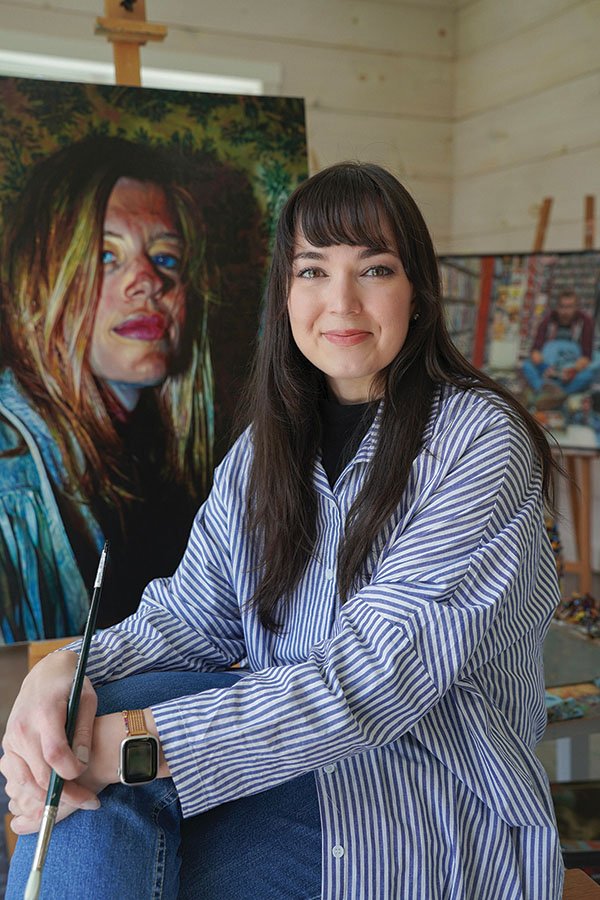
Doris Rose is a contemporary-realist portrait painter based in Ontario, Canada, who has been selected for exhibition in the prestigious HSF Kramer Portrait Award 2026 at the National Portrait Gallery in London, UK. She creates thought-provoking portraiture series and commissions in both traditional and digital media.