

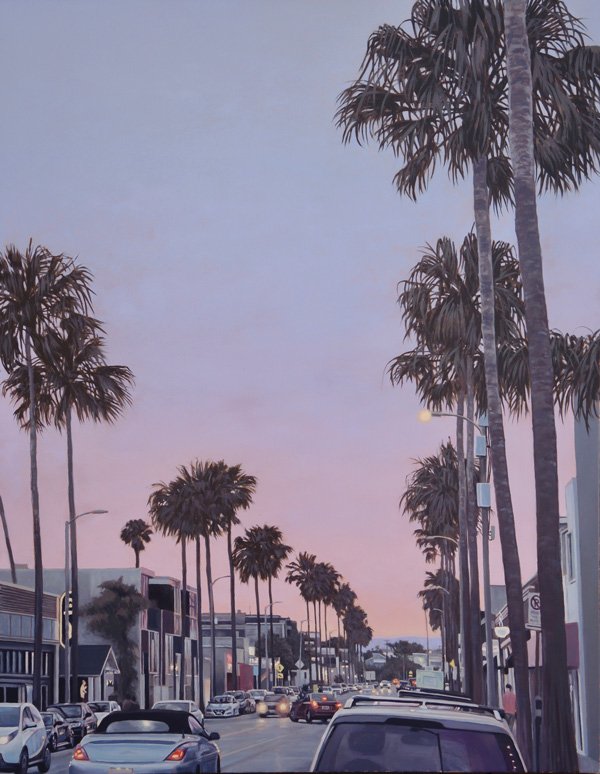
Whether it’s a rain-slicked streetscape or an ocean view, David Marshak paints the same subject: light. His work flows between landscape and cityscape, realism and impressionism, tight and loose — a path he describes as “stumbling forward to destiny.” From days as a Toronto art student and founding member of the 90’s painters’ collective DRAWNONWARD, to painting in a quiet Beaver Valley studio, Marshak always knew that painting was his life.
You studied at OCA — was painting always the plan?
I actually did a split of fine art and illustration, because I always thought I’d keep a commercial avenue open. I did a little bit of illustration when I left, but I didn’t have that handshake-and-portfolio mentality — crisp shirt and all that. So I waited tables at the Spaghetti Factory for a few years and tried to get little things going. I was songwriting, trying to keep up everything. But the few illustration jobs I got were certainly not enough to live on.
So I actually moved out of Toronto, moved back to my parents’ house when I was twenty-four, twenty-five, and just started painting. I did this body of work and sold most of it. I was like, well I guess that’s what I’m going to do.
You were part of an art collective at the time?
It was in ’96. Some friends that I’d made at OCA, who I’d lived with in Florence during my fourth year, started this collective that was eventually sponsored by Scotia Capital Markets. They asked me to join, and we ended up calling ourselves DRAWNONWARD. That was nearly two decades doing that.
We would go into the bush for a month or two — no kids, no wives, could just do it — and paint plein air, then come back and hit the studio for a few months and build up a body of work. And we’d have these huge shows. There were seven of us, and of course we got the moniker of the new Group of Seven which didn’t hurt for media exposure, that’s for sure. But we didn’t plan it that way.
It was almost surreally successful. It was huge, we just hit a vein. There were more than a thousand people at our openings. Huge parties. We did that for years, until about 2012 or ’14, somewhere in there, and then families, kids couldn’t do the long trips anymore. There was conflict, too, around the idea of what we should do next.
There was a documentary made about one of your trips?
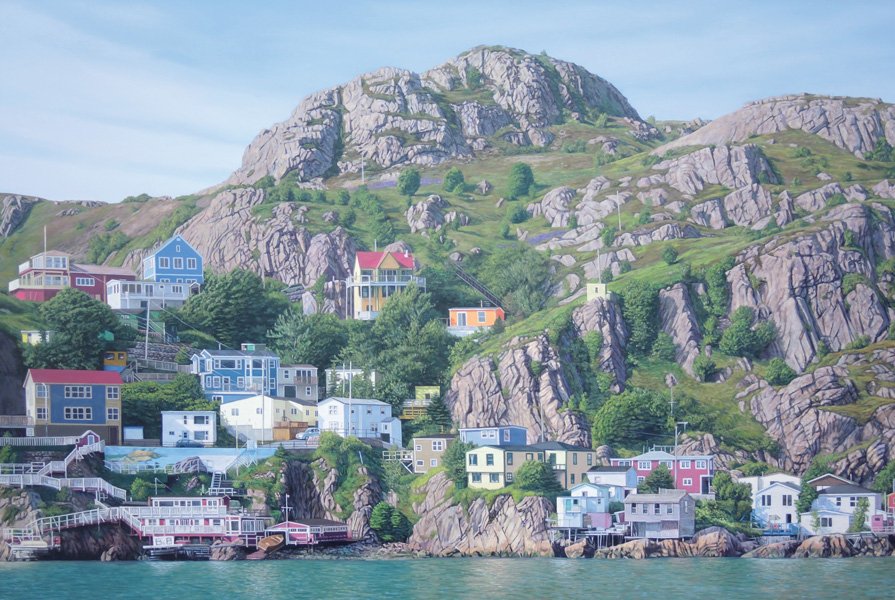
A friend came on our trip to Newfoundland. We bought a school bus and painted it green, printed ‘Research and Development’ on the side, put bunks in it, and drove to Newfoundland for a month, around the island. Our friend Andy Keen, a great filmmaker, still working, made this movie called Seven Painters, Seven Places. It went on to win a Gemini.
It was a wild thing. How was this even happening to a bunch of young landscape painters? Andy’s just a really artistic documentary filmmaker, and he made this cool, kind of off-the-wall, wacky, but really beautiful film. Don from the Rheostatics did the soundtrack. It’s on YouTube.
We were all blown away by what happened. Years later we heard we were actually in art textbooks. Young painters would come up and say, we learned about you in art class. But in the moment, we were all just wide-eyed and giddy, really, about what was — we were on this train.
Did that popularity change the trajectory of your career?
I did think I was going to do album covers and Rolling Stone magazine covers. I kind of wanted to be a rock-and-roll illustrator, back when that was still possible to be a thing. But once I started doing pure paintings and selling a few, I thought, well, what could be better than this. Not being commissioned to do something or instructed how to do it, but developing your own style.
The DRAWNONWARD thing was certainly a huge boost to my career for several years after. Because even if a gallery wasn’t interested in the kind of work you were doing, they’d heard about you — ‘oh yeah, you guys were quite a scene there for a minute.’ Because nobody was throwing huge art shows with landscape paintings and having a thousand people come. It was kind of freakish. And great parties after. It was certainly the beginning of making a living. A schizophrenic living, but a living nonetheless.
How did you end up here in the Beaver Valley?
I’ve lived up here off and on starting in maybe ’96. I would come up for a bit and then move back to the city. And then I had a band in Toronto from 2000 to 2006. I’d be in Toronto for a year or two, think I have to get out of the city, and then it would pull me back in.
But finally, in 2004, I moved out for good. I moved to Newfoundland for a year, outside of St. John’s, in a little town called Pouch Cove. I was in a residency there for just a month and loved it so much. And that just did it for me, for the city, after living right on the ocean for a year.
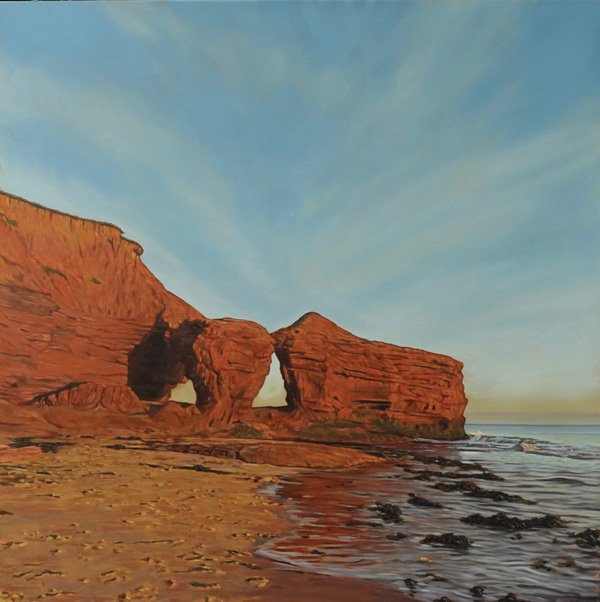
We moved to this property thirteen years ago this summer. I’d never actually been in this valley before, strangely. All my friends were a valley over. The first time we drove up to see this property and came down into the valley, we were like, this is beautiful, what is this? It felt like a little mini-BC vibe — or the foothills, or certain parts of the Slocan. It was just reminiscent.
As for the art community here, I wouldn’t say I’m an isolationist, it’s just a busy life so I’m not really in the mix a lot. Sarah and I had a show at Durham Art Gallery a while back — her photographs of my paintings — and I’m still with Local Colour in Flesherton. I’ve had a couple of good shows there. So, toe in the water. But as per my astrological sign, I suppose — the Cancer — I tend to love my surroundings and stick to them.
What’s your process when you’re starting a painting?
You start from the same place, and with a bit of technique, the rules still apply. Make a drawing, start with toned-down, more muted colours, and build up your chroma. Work from darker to lighter, push and pull. It’s a mixture of natural inclination and choices — a million choices, because there’s a million ways to paint.
At times I’ve gone down to a three-colour-and-white palette, just to challenge myself and see if I could do it. For a while I was painting with what’s called the Zorn palette — black instead of blue, a very muted yellow ochre, a red of your choice, and white. I loved it, I thought I could paint like this forever. It’s got a great portrait vibe, maybe a little anachronistic feeling, but I liked it. Now I’m suddenly back up to about seventeen colours on my palette, drawing from the whole rainbow.
I also try to adhere to the golden ratio to some degree. I find it really works. You can do something straight-on and have it be static, but it’s got to have a reason to be static. Dynamic composition, I find you can’t go wrong trying to employ the golden ratio. It’s all through nature. Even if you watch people’s paths as they walk freely, not on a trail, they drift slightly in the golden ratio.
There’s a real push and pull for me between loose and tight. I admire painters who can paint very loosely, but I get caught up in detail. If I ever have any angst over my work, it’s that. Trying to be looser, and then drifting into tightness again. And when people say, ‘oh, you’re a photorealist,’ I cringe, because I’m not. I am definitely a realist, but there’s still a vein of impressionism, whether it’s latent or not, that runs through my work.
Your work moves between rural landscape and urban scenes. How do you think about the difference?
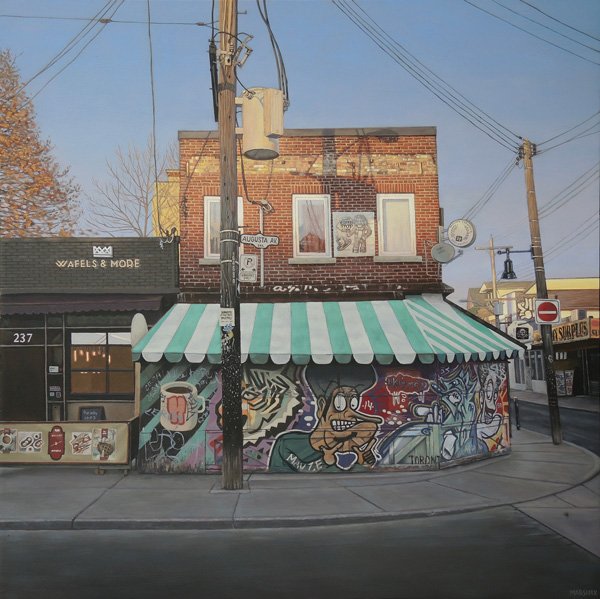
It’s just a natural inclination that it’s all about light. If you’re in Toronto at the right hour with magic light, it doesn’t matter where you are. Everything’s bathed in this gold glow, or maybe it’s grey and cold and sleety, but there’s an aesthetic to everything. It’s just a matter of whether you’re the kind of artist that appreciates that or wants to try to tackle it as subject matter. I always loved the artificial light of a night scene, or wet pavement, or stark grey, kind of toned-down chroma. It really doesn’t matter — half my day, wherever I am, I’m looking around thinking, how would I paint that.
Does your process change for an urban scene versus a landscape?
I rarely, if ever, do plein air in an urban setting. I take my own photos, thousands of them, and end up painting one out of several hundred, probably. Certainly with urban work it can be more exacting, because I get caught up in detail. That’s the same push and pull as before.
When you’re out shooting in the city, are you thinking like a painter or like a photographer?
Both, really. You in a way have to think like a photographer, but now with digital photography it’s so easy, you don’t really have to. I did take photography at art college too, but the technical side I didn’t really internalize. I just loved going out with a camera trying to get great shots. Now, put it on aperture priority and that’s handled. But I still stop up and down. I’ll still expose for the sky and then bring it down so I get the buildings in a proper exposure, and blend the two.
It doesn’t hurt that my wife’s a professional photographer. She’s given me tons of tips. But I do love photo missions. I love the feeling of just setting out and trying to find something.
Has having a family changed how you approach work?
I think I was born a visual artist. I always drew when I was a kid, or made clay sculptures. I still make clay sculptures.
I always say I’ve got three big interests: painting, music, and cooking. Most of my days are engaged in thinking about those three things. And then, feeding children.
That’s the stumbling-forward-to-destiny thing, really. You don’t know what’s going to come. If you’re going forward with some degree of confidence and gratitude in your circumstances it’s going to work out. Having kids was a huge change, but I never fought against it. I just accept it and love it. I don’t need to be fifty-six and in a band, in the clubs in Toronto, staying out till four in the morning.
Certainly in my twenties and thirties and early forties, I could paint for twelve, sometimes sixteen, even eighteen hours straight, then collapse and take the next day off. Now it’s a good day if I get five to eight hours. With an eight-hour day I feel super accomplished, because I also do all the cooking. It’s all part of the give and take of a long artist’s journey.
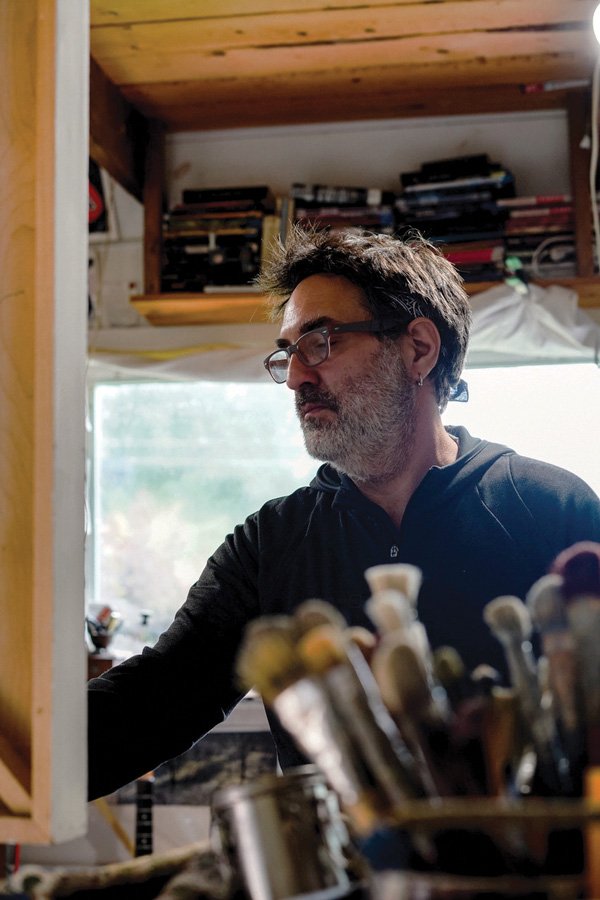
Tell me about your studio setup here.
The fact that it’s fifty feet from the house is pretty good. When we moved to this property, the barn — which we’ve now renovated and insulated — was a huge draw. It had two spaces in it, one for Sarah and one for me. It’s hard to imagine ending up in a better situation. I have a lot of friends whose studios are a drive from the house. Some people need that separation between work and life. I love being able to just stumble out of the house, right into the studio, and then go make lunch, or whatever it is, in the summer. It’s a great setup.
My nature is pretty comfortable with long periods of solitude, too. In Newfoundland I’d go into St. John’s and hang out with friends, but there’d be long stretches of just being by myself, working, staring out at the ocean, listening to tunes and podcasts and writing songs. If you keep yourself artistically interested, you can tolerate huge periods of solitude.
Sarah and I see each other in the morning on busy days and at the end of the day on busy days, and on quieter days, we’re both just here. Neither of us has to leave for work, which is such an amazing thing to have, if that suits you. Other people would drive each other crazy, but for us, it’s pretty ideal.
David Marshak is a Canadian artist and painter known for his lush landscapes, richly detailed urban images, and meditative skyscapes. David is represented in the GTA by Roberts Gallery, in Charlottetown by Details Fine Art, and in Newfoundland by James Baird Gallery.