

When I was a child, my father would regale me with stories of his experiences attending live performances in the vibrant theatre life of his youth in Hamilton. At the time, the city had the honour of having the most live theatres per capita in North America. It had achieved this unlikely status simply because it was part of an unusual circuit, the “TH&B” (Toronto, Hamilton and Buffalo) railway, and it owed its success to the popularity of vaudeville.
Pick the right week and a show in Hamilton might offer an audience a chance to marvel at Blackstone the Magician, or to laugh at a young W.C Fields or even the Marx Brothers.
During its heyday (1900-30), an evening of vaudeville might appear to a present-day viewer as something like a variety show — a series of acts, maybe 10 or 15, that might involve comedy, dance, singing, musical performance, magic, ventriloquy, juggling, mime and even animal acts.
Although vaudeville as we know it began in late 19th century New York City, its roots can be traced back to medieval Normandy, and much later, to Paris. In New York, it started with Tony Pastor, who promoted a clean, family-friendly evening for his patrons, and he grew his empire to multiple locations where he could provide nightly entertainment.
By the early 20th century, the demand for vaudeville had grown to such an extent that there were many booking agents, such as B.F. Keith, William Morris, and Alexander Pantages, who would exclusively contract with performers, for a percentage, to provide them access to performance venues all over North America, both large and medium size capacity.
There was a Canadian equivalent to this practice, albeit on a much smaller scale. John Griffin was already considered the “father of motion picture houses in Canada” after he opened the “Theatorium”, Toronto’s first permanent movie house.
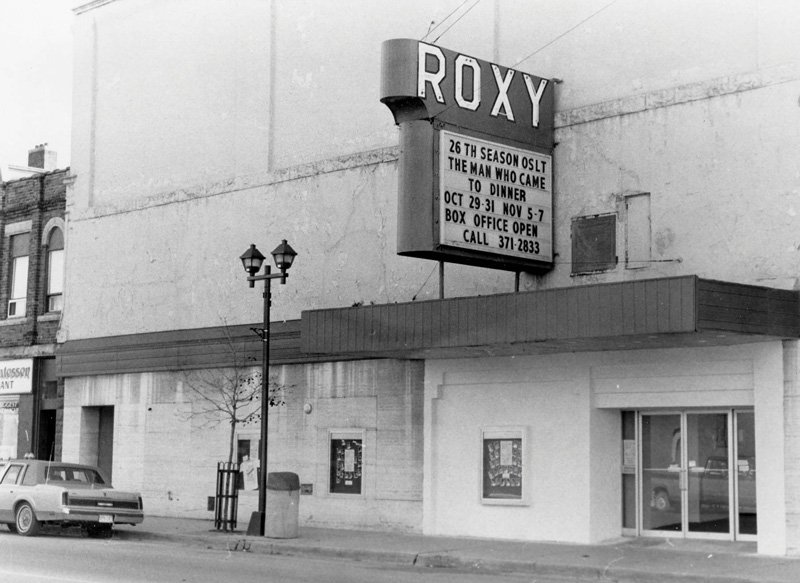
Griffin also owned more than thirty performance houses throughout Ontario, one of which was the theatre now known as the Roxy in Owen Sound. He partnered with theatre impresario Ambrose Small (who later disappeared mysteriously), and the two relied on their respective skills in booking acts to bring quality entertainment to communities which might not otherwise be exposed to them.
By 1915, John’s son, Peter, managed the Griffin Vaudeville Circuit, also known as “The Hideaway Big Time”, a booking agency with a Head Office in Toronto, and branch offices in Montreal, Detroit and Buffalo. They had access to over 200 acts, any of which could be dispatched to theatres in Ontario, Quebec, and the northern states bordering Canada.
With the Savoy Theatre on 2nd Ave. E and the Griffin Opera House on 9th Street E., vaudeville was alive and well in Owen Sound in 1914. Here, as in many theatres all across North America, with just the right equipment in place, a savvy manager would intersperse the live acts with that other timely rage, the moving picture, so as to tuck a few extra dollars into his waistcoat.
After all, it was significantly less expensive to show a film for a week than to engage another stage act. Gradually, the experience of live performances separated by moving pictures became moving picture with the occasional live act interspersed.
And then there were just the movies, and the only sound in the room was that of the guy playing the piano. In 1916, at the Griffin Theatre in Owen Sound, site of the present day Roxy, one could watch D. W. Griffith’s “The Birth of a Nation” with full orchestra for a quarter.
The advancement of technology, like it or not, is the great equalizer. The printing press gave the common man a shot at knowledge; the telegraph provided the means to transport information across the ocean.
After the silent movies pushed the three-a-day shows off the stage, the silents were banished by the talkies, until the talkies floundered when the audience stayed home to focus on the radio, and then the television, which then gave way to the computer, then the phone, and even the watch, courtesy of the internet.
Viewers can now experience all of cinematic history on a screen a little larger than a bandaid, isolated and devoid of anything so intrusive as an audience. It underlies the truth that Norma Desmond once told: “I am big. It’s the pictures that got small.”
Some might say that vaudeville never really left us, that it has left traces in all forms of popular entertainment still being produced. I once wrote a play about a notorious Hamilton murder that performed like a hybrid of courtroom drama and vaudeville show. Anyone watching a political debate might suggest that it has seeped into other areas as well.
The good news is that live theatre, that thing that used to bring folks out to experience something as a community, is still flourishing in Grey County. The Roxy Theatre is performing Come from Away, a vaudeville show if ever there was one, as its 2026/27 season opener from November 5-21. Call the Box Office at 519-371-2833 for more information.
Kevin Land is a playwright, director, producer, and educator. He owns Speaking Volumes Books and Audio in Markdale.