

Some places continuously inspire. For Owen Sound artist Kristine Moran, each visit to Moreland Place unlocks fresh inspiration, feeding a process that moves intuitively from line drawings to luminous large-scale canvases. It’s a practice built on layers of meaning and sustained by the strong circle of community she’s found along the way.
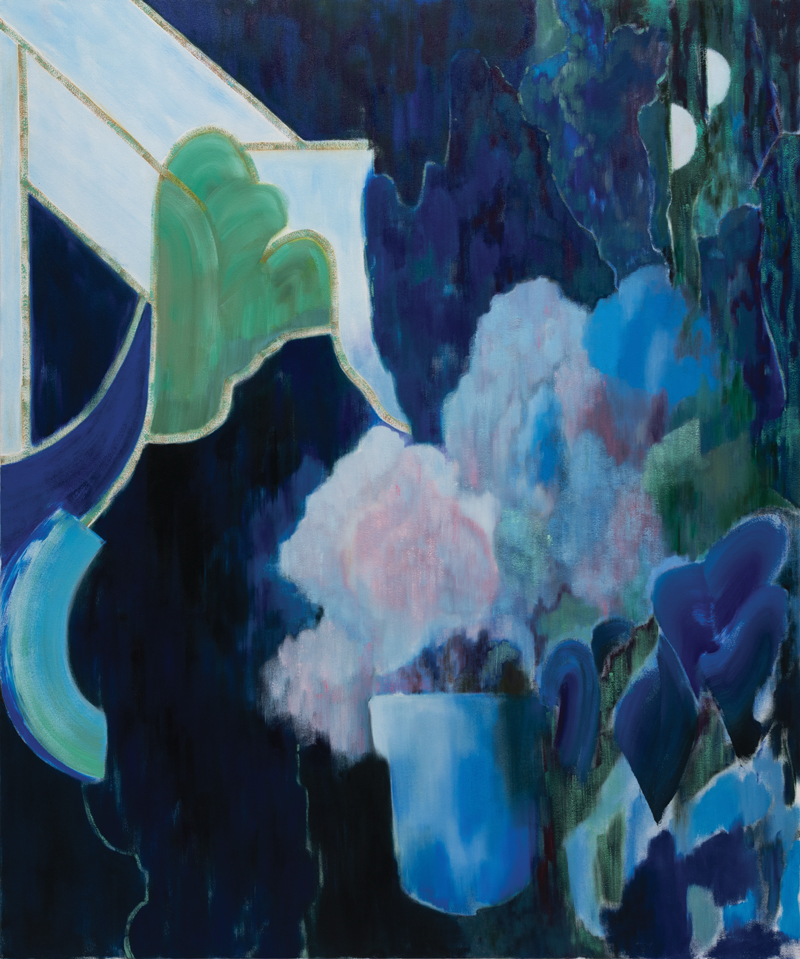
Image courtesy the artist. Image by LF Documentation.
Tell us about your journey to becoming a painter.
I first studied Landscape Architecture, but it wasn’t the right direction for me. I’m better suited to long, solo days in the studio, and I wanted the freedom to follow my own line of inquiry. I applied to the Painting program at OCADU in Toronto, where I found a way of working that aligned more closely with how I think and work.
My mother had an art practice while I was growing up in a suburb of Montreal. She had a studio in the basement of our house and worked with oils and oil pastels. It had a strong impact on me. I used her materials and began oil painting at a very young age. My mother passed away while I was in my third year at OCADU and never saw my first gallery exhibition, but I feel grateful for the connection I have with her through my art practice.
After graduating from OCADU, I moved to New York to pursue an MFA at Hunter College. Throughout much of my career, I centered my work around personal experience, working through things such as my mother’s death, my own mortality, and raising children. Over time, I was led back to the landscape, not as observation but as a way to construct something else. It became a space to work through desire, distance, and the idea of an alternate reality.
At the same time, I began creating abstract spaces rooted in my drawings through space, as a way to reconstruct something in my mind — possibly from childhood, or as another form of escape. Each iteration, or new painting series, builds on the previous one, both in mark-making and in concept.
Moreland Place has been an inspiration for you, what takes you there?
From speaking to Barry at Moreland Place — who he is as a person and his history — it feels as though he’s created his own pleasure garden. It’s a passion project for him. He puts so much labour and love into this property. The perennial garden is an ongoing obsession. He’s said to me that it’s never done, and he’s always talking about how he has so much more to do. There’s something interesting about that, about this obsession over something that you can’t let go of. l’m drawn to that idea.
Every time I go, I bring my sketchbook. This is how I’ve been working since about 2022, going to the property and doing quick line drawings as I’m walking around. I’ve been calling this project “drawing while walking.”
I try to incorporate parts of particular elements as I see them, architectural details of the greenhouse, parts of his garden, the stone sculptures he’s made, and the stone paths leading from one space to another.
I’m not interested in a particular vista. I’m more or less deconstructing the space and then reshaping it into something that answers questions for me.
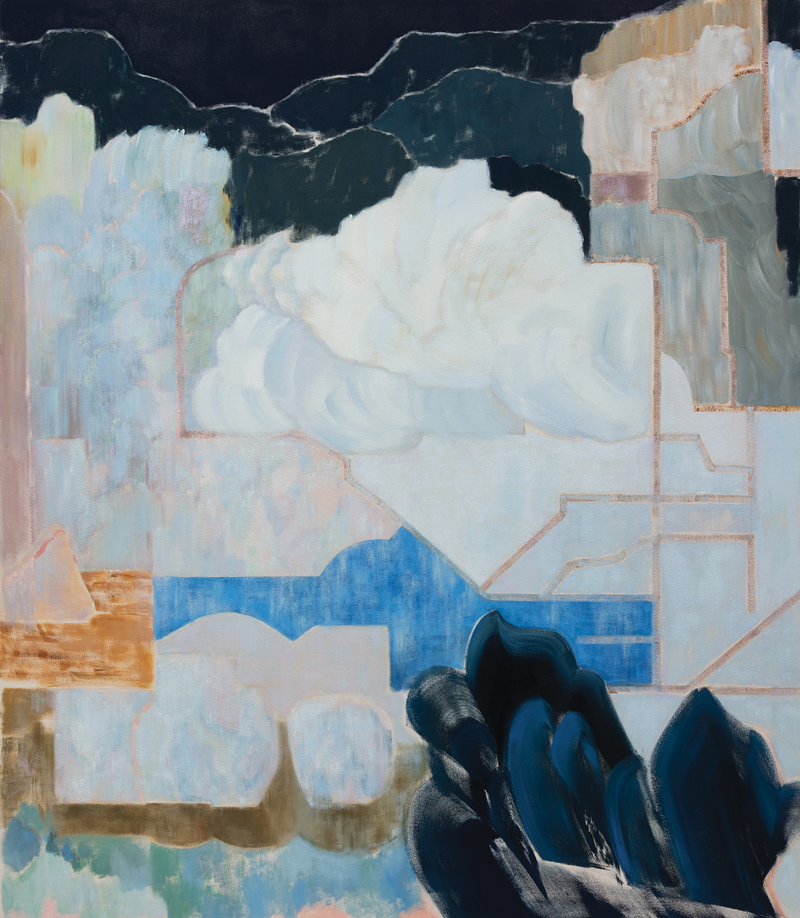
Image courtesy the artist. Image by LF Documentation.
Are you interpreting it as you go, or is it more a reproduction of what you’re looking at?
I would say I’m reinterpreting it, to the point where it becomes something completely different. I’m interested in shapes and colour, in making something that is a little unexpected and unique that might connect to a memory that I have, but at the same time something that I’ve never seen before. It’s a mix of reality, what’s going on in my head, and also a sense of longing. It’s a confluence of all these things at once.
It doesn’t really matter to me where the original sketch was made. I often lose touch with the geography of the original space. Even within that space, I lose track of what I was looking at once I get into the oil on paper. I like that because it’s a way for me to have a framework for which to start a painting with, it’s something that I have an emotional and physical connection to. But once back in the studio, I can reshape it into something I’m grappling with.
It might be a desire I’m after, or a nostalgic space I can’t quite access. That’s what I’m trying to discover through the paintings.
There’s an element of space to your paintings, similar to how a garden or landscape is designed to elicit an experience. Are you conscious of creating space within a painting in the same way?
Yeah, absolutely. I think it’s a way to ground abstract painting. I use abstract painting to open up the landscape, or vice versa — the landscape is a way to ground abstraction. I appreciate a slow read in a painting — something that slowly reveals itself over time. The more you look, the more you discover. I find that fascinating. I’m very curious about human nature and how we interact with space and patterns.
This led you to researching the idea of Pleasure Gardens. How does that feed into the new work?
What I’m finding through reading the book The Pleasure Garden, from Vauxhall to Coney Island, is the many public-facing gardens in England and beyond draw on the model of the 18th and early 19th century pleasure garden, spaces that were designed for leisure, spectacle and social interaction.
They borrowed heavily from aristocratic landscape design. There’s a lot of detail around how these spaces were used, people spending time there during the day in a more structured, social way, while at night the atmosphere shifted, allowing for more anonymity, class mixing and looser social behaviour.
What attracts me to these spaces, like the botanical gardens and Moreland Place, is how they’re constructed to feel almost perfect, guiding the viewer in a certain way. It’s a curated experience, with utopian endeavours. I also like that there’s a duality between the serious aspect of conservation, the science of botanical research, and at the same time there’s a need to engage the public. That’s when aspects of spectacle and entertainment come in, which has its historical roots in pleasure gardens and later amusement parks. I find that tension compelling.
I’d like to center my next exhibition around the idea of the pleasure garden. I think it’s an open enough thematic idea that other things can still come into it. I don’t want the work to be didactic or restrictive. I don’t want to box myself in. I’d rather see where the work goes and be open to it.
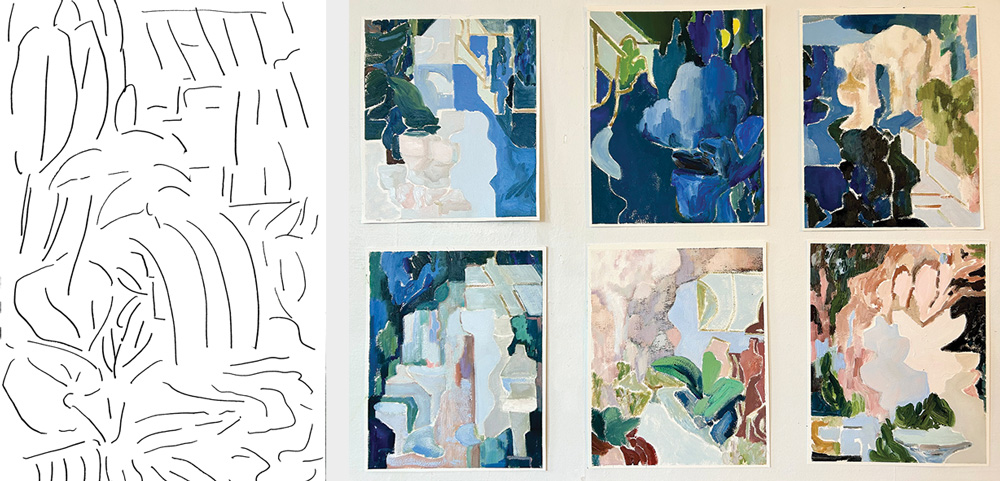
Can you walk me through your process — from the sketchbook drawings, to the oils on paper, to the large canvases?
I have at least a dozen sketchbooks on the go. The drawings I find most successful, l scale up into oil on paper. Usually about 16” x 12”, so still on the small side. I use Arches oil paper, so I don’t need to prime it, which helps me to not be precious about it. Taking out that step means I can get into it quickly and if it fails, it’s fine, onto the next.
There’s something about paper, psychologically, that allows me to be more open to experimentation, and let colour lead the way to composition in an intuitive way.
And what tips you from the oil on paper to committing to a large canvas?
I’ve been thinking about this recently. There are times I go through my sketchbook and think: “no, none of these drawings are speaking to me right now.” Then two months later, I’ll look again and think “this is exactly what I was looking for.”
If I look too soon after making the drawings, I’ll be like, oh, I got nothing. With time and a bit of contemplation, I begin to see the drawings differently. It’s also true that for me, the context of what’s happening in my life will affect how I perceive the work. In that sense, it’s unpredictable whether a certain drawing will make it to a painting at first.
I see potential in many of my line drawings, because at that stage, it’s very open, it could be anything and go in any direction. But when I bring them into oil on paper, something maybe goes wrong and it diverges too far from the initial idea. Once it’s lost I often don’t give it a second chance.
I’ll aim to have around 50 oils on paper before deciding which ones to scale up as large paintings on canvas. Then it becomes about what works together and what tells the story that I’m trying to convey the best.
You describe moving from the small works to the large canvas as a translation, not a transfer. Can you explain what you mean by that?
Once the painting scales up, the change in brush size alone alters the painting. And so the large painting really does become its own project.
I think of painting as a bit of a chess game. You’re going back and forth — I make a move and I sit there and wait for the painting to make its move and then respond to it. With the smaller ones it happens a lot more quickly. But with the larger format, sometimes it can take weeks before the next move is applied because I can’t figure it out. I sit with it, step away, and eventually come back with clarity.
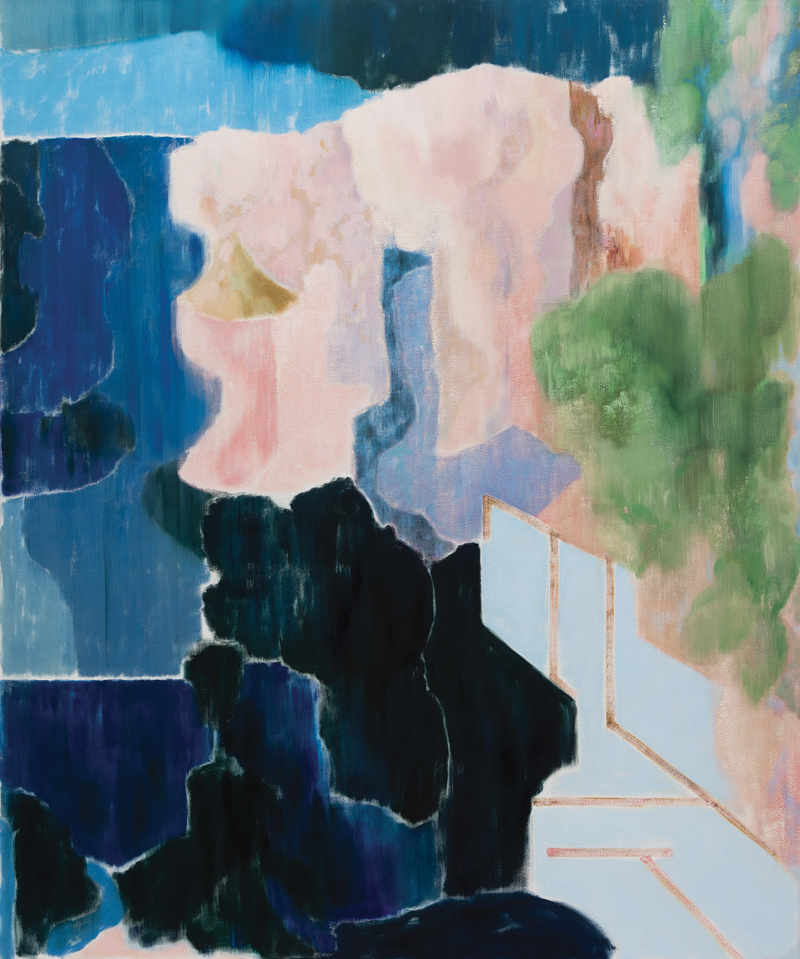
Image courtesy the artist. Image by LF Documentation.
Your paintings use abstracted architectural and landscape elements to suggest a space, rather than depict one. Is that intentional?
For a while last year, I was thinking a lot about archways — how they suggest the promise of something just beyond. I was trying to work through that idea.
In one painting, I was trying to reach something I couldn’t quite access — possibly a childhood memory, or something imagined. A path with water, structures, maybe a canal lined with buildings, and something just beyond reach at the end. That’s where I was trying to go.
What is this space in the back of my mind that I’m trying to reach?
It’s an impossible task, like trying to paint a dream. You can’t fully get there.
Now I’m thinking more about excess, frivolousness and grand events, the descriptions of pleasure gardens in the 17th and 18th centuries — a lot of night lights and dark corners, but also sculptural and architectural elements of that time. That’s informing how I look at my new drawings. It will usually come down to a mix of interest and something in my past, a memory I can’t fully identify, that I’m trying to understand.
You spent a year travelling across North America with your family, and ended up in Owen Sound after living in Brooklyn. How did that change your practice?
For years while living in Brooklyn, I was working with thicker, more impasto brushwork. Then we traveled for a year cross-country in a trailer. I was painting the whole time but on small canvases, eight by ten inches, because of the space restriction. I kept my materials in a box under the bed.
We were driving a lot, and I was drawing constantly. That’s where the drawing while walking initially took shape, though it was really drawing while in motion as a passenger in the car.
Being in a different phase of life gave me permission to change how I worked. I shifted to thinner layers out of necessity, and that has stayed with me. Over time, these accumulated marks and techniques become part of my painting vocabulary, one that I can draw from for each of my paintings.
And how did you end up settling in Owen Sound specifically?
After travelling, we visited many towns to see how it felt — even all the way out in BC — but then we knew we wanted to be closer to family. We have family in Southern Ontario. We went to Peterborough and then Collingwood and Meaford and then Owen Sound just felt right. We stayed at Harrison Park campground and started meeting people there. Our kids were five and seven, and people were telling us about the schools in the area. It felt open and easygoing.
We love it now. I feel connected to the community. My kids have had a good childhood here. I love my studio space and the community at the Harmony Centre. I’ve found a strong circle of friends in the art community. It feels grounded.
Kristine Moran is a mid-career visual artist best known for having a painting practice that employs an abstract approach to convey autobiographical experiences. Her work is included in the collections of the Buffalo AKG Art Museum, the Glenbow Museum, the University of Toronto and the Tom Thomson Art Gallery. She is represented by the Daniel Faria Gallery in Toronto.