

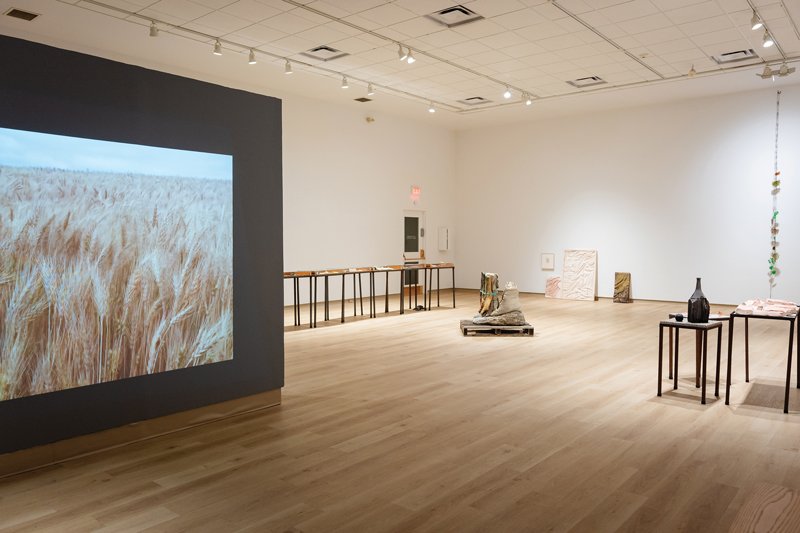
Photo by John White.
What does it mean to transform a landscape, and how do the materials we take from the earth shape our relationship with the natural world? These questions are at the heart of cut a path through the weeds and call it a garden, a new exhibition by D’Andrea Bowie at the Tom Thomson Art Gallery.
The exhibition takes its title from a simple act of intervention on the rural property where Bowie lives and works in the Whitchurch-Highlands, north of Toronto.
Rather than continually mowing the vegetation growing on the land, Bowie began cutting paths through the overgrowth, creating new ways of moving through and experiencing the landscape.
This gesture prompted a broader consideration of how we define, organize, and assign value to the natural world. At what point does an overgrown field become a garden, and what does that distinction reveal about our desire to impose order on nature?
These questions extend into Bowie’s sculptural practice, which explores the relationship between material, process, and place. Working with plaster, cement, ceramics, copper, glass, and stone, she investigates materials drawn from the earth that have long been used to construct buildings, infrastructure, and the environments we inhabit.
Through experimentation and transformation, her work reveals the connections between geological processes and human intervention.
For this exhibition, Bowie turns her attention in part to the distinctive geology of Owen Sound and the surrounding region, a landscape that has long inspired her work. At nearby Bruce Caves Conversation Area, she studied the intricate relationships between exposed root systems and the underlying rock formations.
These observations informed Bruce’s Cave, a sculptural plaster relief developed from drawings of the site. The resulting mold was then used to create Deeprooted, a ceramic work incorporating a handmade glaze containing locally quarried limestone.
In this way, the region’s geology is not simply represented in the artwork but becomes part of its physical composition.Elsewhere, Bowie considers how land is measured, divided, and claimed. Gunter’s Chain references a historical surveying instrument once used to establish property boundaries.
Entangled within the steel chain are delicate glass and ceramic leaves, their skeletal forms inspired by patterns left behind by beetles feeding on grape leaves on the artist’s property. The work brings together systems of human measurement with the unpredictable processes of the natural world.
Throughout the exhibition, Bowie encourages visitors to slow down and consider the histories embedded within seemingly ordinary materials. Her sculptures reveal a world in constant transformation, shaped by geological time, organic growth, and human activity.