

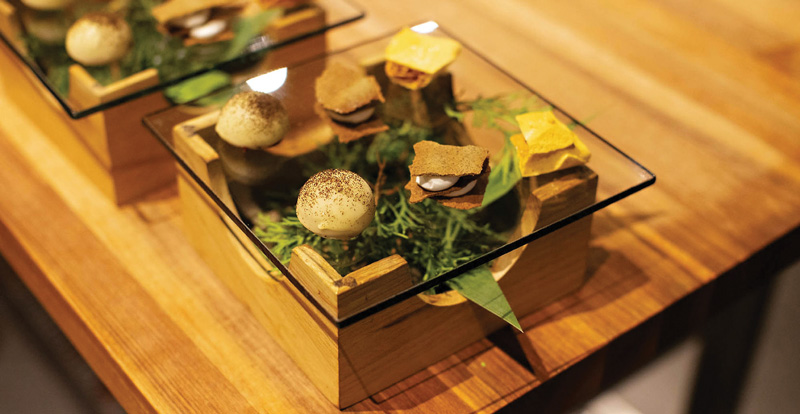
Chef Zach Keeshig, creator and owner of Naagan — the Owen Sound restaurant recently named by Time Magazine as one of the World’s Greatest Places of 2026 — is a master storyteller.
And stories, it seems to me, go quite naturally with food. Indeed, when food scholars and writers speak of foodways, we speak of the cultural knowledge and belief, the figuration of social relationships, and the ways of gathering, shaping, preparing, and sharing sustenance that are embedded in the food traditions of a people. That is, where our food comes from, how we gather or procure our food, what we make of it, how we share our food and with whom, are the foodways that emerge from our collective histories. Our foodways are stories we nurture about who we have been, are now and may become.
Every dish served at Naagan is a story composed by Chef Keeshig. His stories are told as diners are introduced to the locally sourced, foraged ingredients that compose each dish, and to the combining of Indigenous and western culinary methods by which each dish is prepared. Each story is deepened as bodies as well as spirits are nurtured by the sharing of Chef Keeshig’s cuisine.
The experience of dining at Naagan is magical. Foraged sweetgrass, sunchoke, knotweed, sweet clover, and lemon grass hang to dry from pine beams. Paintings and prints by Indigenous artists hang on the restaurant’s pine-paneled walls alongside objet d’art created in the meeting places of wind, water, fire, and earth. A galley kitchen and shelves of the most fascinating assortment of “plates” (ceramic turtles, birch plates, bison skulls, etc.) are positioned along the left side of the main room, while tables for seventeen lucky diners are carefully spaced for mobility and access along the right.
Each course (loosely, four starters, four entrees, and four desserts) is finished and plated in the galley kitchen and each is preceded by its story. Diners learn a little of the place of principal ingredients in Ojibwe foodways; learn where and how principal ingredients were foraged by Chef Keeshig and his assistants; and the culinary methods — both Ojibwe and western — that have been braided to produce the dish now placed before each patron. Beautifully plated, the flavours of each dish progress along the tongue: layered, complex, and fantastically textured.
I will not give away the menu I partook in its entirety but rather give you a hint, a sense of the courses. One of our favourite dishes of the night was a lion’s mane mushroom bite finished over charcoal, gently seasoned with salt, and served with a frothy reduction of whey reserved from the yogurt base for the first of the starter courses. The interplay of the mushroom’s umami with the light, tang of whey was breathtaking! This dish was served in a handcrafted pottery bowl, lightly distressed.
From Bannock to bison, tartlet to duck breast, sweet clover ice cream to chaga, we wondered as we ate and talked, “how did he even think of this?!” And that, I am quite certain, is the question every fine artist hopes will be asked of their work.
There is nothing old, tired, or stodgy about the food Chef Keeshig is serving. Rather, this food is a most generous introduction to foodways eons in the making, and to communities whose spirits as well as bodies are sustained by the beauty and plenitude of the lands, riverways, and lakes that are the homelands of the Ojibwe Peoples of the Saugeen Peninsula.
From dishes created by Michelin chefs to the plethora of farm, woodland, lake and stream ingredients in use, from avant garde and haute cuisine to an array of culinary traditions and cultures, writer Frankie Condon explores the diversity of fine dining experiences available along the shores of Lake Huron, the Georgian Bay, and the villages and towns of the Saugeen Peninsula.
Frankie Condon works as a professor in the Department of English at the University of Waterloo. She is a writer of creative nonfiction, memoir, and poetry as well as of scholarly prose.